Test Index
UACE Biology 2022 Paper 2 (Theory)
© africaexams.com
Question : 6
Total: 6
Solution:
What we are solving(a) The meaning of isolating mechanisms(b) How each type of isolating mechanism stops gene flow and so allows a new species to ariseChapter: EvolutionTopic: speciation and isolating mechanismsConcept and formulasA species is a group of organisms that can interbreed to produce fertile offspringA new species arises when part of a population can no longer exchange genes with the rest: its gene pool changes on its own until the two groups cannot interbreed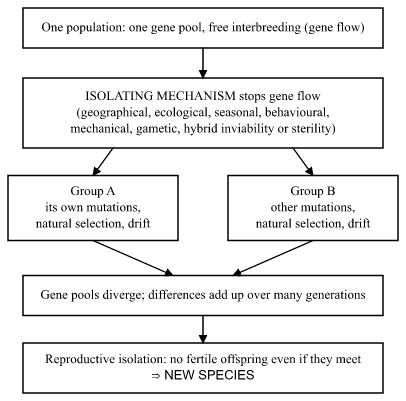 Working(a) (2 marks)Isolating mechanisms are barriers or factors that prevent interbreeding (gene flow) between populations or groups of organismsso that their gene pools are kept separate(b) (18 marks)How any isolating mechanism leads to speciation: it splits one gene pool into two; each group then gets its own mutations, is acted on by different natural selection pressures, and (if small) by genetic drift; the gene pools diverge until the groups can no longer interbreed, and they are new species1. Geographical isolation (allopatric speciation):A physical barrier such as a mountain range, sea, lake, river, desert or a large valley separates two parts of a populationThe two groups cannot meet, so there is no gene flow between themThey live in different environments (climate, food, predators), so different alleles are favoured by natural selection; mutations and genetic drift add further differencesOver many generations they become so different that, even if the barrier is removed, they cannot interbreed: e.g. Darwin's finches on the Galápagos islands, cichlid fishes in separate East African lakes2. Ecological (habitat) isolation:Groups living in the same area occupy different habitats (e.g. on land and in water, on different host plants, at different heights) and so rarely meet to mateSelection adapts each group to its own habitat; without gene flow they diverge into new species (sympatric speciation)3. Seasonal (temporal) isolation:Groups breed or flower at different times of the day or seasons of the year, so their gametes are never available togetherGene flow stops and the groups evolve separately into new species4. Behavioural (ethological) isolation:Courtship behaviour, songs, calls, colours, displays or pheromones differ, so members of one group do not attract or accept mates of the otherMating occurs only within each group, so the gene pools stay separate and diverge5. Mechanical isolation:The reproductive organs (genitalia of animals, or the structure of flowers in relation to pollinators) do not fit, so mating or pollen transfer between the groups failsNo gene flow occurs, leading to separate evolution6. Gametic isolation:Even when mating or pollination occurs, the gametes are incompatible: sperm do not survive in the female tract or cannot recognise the egg; pollen fails to germinate on the stigmaNo zygote forms, so the gene pools stay separate7. Hybrid inviability:Fertilisation occurs but the hybrid zygote or embryo dies early because the two sets of genes or chromosomes do not work togetherNo hybrid adults, so no genes pass between the groups8. Hybrid sterility:Hybrids survive but are sterile because the chromosomes from the two parents cannot pair in meiosis, e.g. the mule (horse × donkey)No fertile offspring means no gene flow, so the parent groups remain separate species9. Hybrid breakdown:The first-generation hybrids are fertile but their offspring (F₂) are weak or sterile, so the hybrid line dies outPolyploidy (genetic isolation): failure of meiosis can produce polyploid offspring (e.g. tetraploid plants) that cannot produce fertile offspring with the parents; a new species arises in one generation, as in many crop plantsConclusionEvery isolating mechanism works the same way: it stops gene flow, so mutation, natural selection and drift change the separated gene pools independently until the groups can no longer interbreed: new speciesAnswer: (a) barriers that prevent interbreeding (gene flow) between populations, keeping their gene pools separate(b) geographical, ecological, seasonal, behavioural, mechanical, gametic isolation and hybrid inviability, sterility and breakdown each stop gene flow, so the groups diverge into new speciesTip: For each mechanism, say what it is, give an example, and link it to "no gene flow → separate gene pools → divergence → new species"
© africaexams.com
Go to Question:
Advertisements