What we are solvingSpecimen Z is a freshly killed insect with two pairs of wings and very long hind legs (a grasshopper or locust)
We name its order, measure body widths and limb lengths, explain what they mean for its life,
then dissect it to show the abdominal viscera and the structures on the ventral cuticle of the thorax
Chapter: Diversity of living organisms; insect structure (comparative anatomy)
Topic: classification of insects, adaptations for locomotion, dissection of an insect
ConceptStructure fits function: wide thorax = room for flight and leg muscles; long hind legs = jumping (saltatorial)
The thoracic ganglia on the ventral cuticle control the legs and wings of each segment
(a) (05 marks)Order:
OrthopteraReasons (features seen with the hand lens):
1. Two pairs of wings; the fore wings (tegmina) are narrow, thickened and leathery
2. The hind wings are large, membranous and folded like a fan under the fore wings
3. Hind legs are much longer than the others, with a large swollen femur (jumping legs)
4. A large saddle-shaped pronotum covers the dorsal and lateral sides of the prothorax
5. Biting and chewing mouthparts with strong mandibles
6. Short, many-jointed antennae; a pair of short cerci at the end of the abdomen
(b) (04 marks)Measure each widest region across with a ruler, to the nearest mm
Sample readings (your own readings will differ):
| Part | Width (mm) | Significance of the measurements |
|---|
| Head | 6 | The thorax is the widest part: it holds the large flight muscles and the leg muscles and carries three pairs of legs and two pairs of wings.The head is narrower and the abdomen tapers backwards to a narrow last segment, so the body is streamlined and meets less air resistance in flight and when jumping through grass.The long narrow abdomen can be stretched and pushed into the soil by the female to lay eggs, and it is moved in and out for ventilation. |
| Thorax | 8 |
| Abdomen | 7 |
| Last abdominal segment | 3 |
(c)(i) (02 marks)Stretch each limb straight on a ruler; measure from the base of the coxa to the tip of the tarsus
Sample readings (your own readings will differ):
| Limb | Length (mm) | Ratio |
|---|
| Fore limb | 15 | 15:45=1:3 |
| Hind limb | 45 |
Divide both lengths by the fore limb length
Ratio=1515:1545=1:3(c)(ii) (3½ marks)The hind limb is about three times as long as the fore limb (ratio about
1:3)
1. The long hind limbs are jumping (saltatorial) legs: they push the body off the ground with great force
2. The long femur holds large extensor muscles, and the long tibia acts as a long lever, so the jump is long and fast
3. Jumping lets the insect escape quickly from predators such as birds and lizards
4. The jump also launches the insect into the air for take-off in flight
5. The short fore limbs are for walking, clinging to grass stems and holding food while feeding
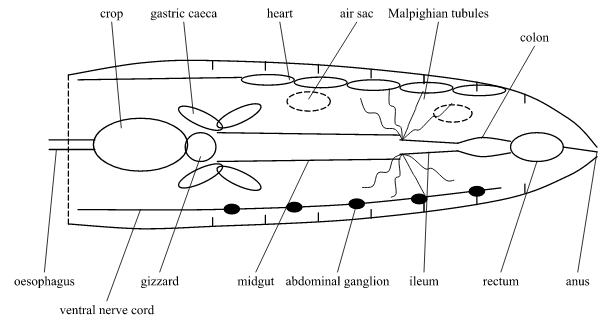
(d) (14 marks)Pin the specimen on its right side in the dissecting dish and cover it with water
Cut along the left lateral line from the end of the abdomen to the thorax; lift the left body wall away
Remove the fat body; leave the gut, heart, nerve cord, tracheae and Malpighian tubules in place
Draw a large clear outline in pencil, with ruled label lines that do not cross, a title and the magnification
Title: Drawing of specimen Z dissected from the left side to show the abdominal viscera
Structures to label: crop, gizzard (proventriculus), gastric caeca, midgut (mesenteron), Malpighian tubules,
ileum, colon, rectum, anus, heart (dorsal vessel) with its chambers, air sacs, tracheae, spiracles,
ventral nerve cord and abdominal ganglia (reproductive organs are left out, as asked)
(e)(i) (01 mark)Pin the ventral cuticle flat and measure its length with a ruler from the front of the prothorax to the anus
Sample reading (your own reading will differ): length of ventral cuticle = 40 mm
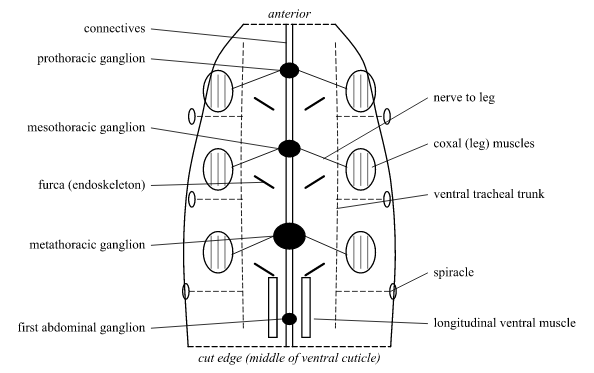
(e)(ii) (8½ marks)After the alimentary canal is cut away, the ventral cuticle of the thorax shows the nervous and muscular structures
Title: Drawing of the anterior half of the ventral cuticle of specimen Z (inner surface)
Label: prothoracic, mesothoracic and metathoracic ganglia (the metathoracic ganglion is the largest), paired connectives,
nerves to the legs and wings, coxal (leg) muscles, furcae (endosternites), longitudinal ventral muscles,
ventral tracheal trunks and spiracles, first abdominal ganglion
(e)(iii) (03 marks)1. Each thoracic ganglion controls the legs and wings of its own segment, so walking, jumping and flight are coordinated quickly, even without the brain
2. The large metathoracic ganglion controls the powerful hind legs, giving a fast reflex jump to escape danger
3. Nerves carry impulses from the ganglia to the leg and wing muscles, which contract to move the limbs
4. The furcae (internal skeleton) give firm points of attachment for these muscles, so they can pull strongly
5. Tracheae and spiracles bring oxygen straight to the active muscles for aerobic respiration and energy
Answer: (a) Orthoptera; (b) thorax widest, abdomen tapering: room for muscles, streamlining, egg laying;
(c) fore : hind limb about 1 : 3, hind legs for jumping; (d), (e)(ii) labelled drawings as shown; (e)(iii) ganglia, nerves, muscles, furcae and tracheae work together for movement and escape
Tip: A cockroach (Dictyoptera) has all three pairs of legs almost alike (ratio about 1 : 1.5) for running; very long hind legs point to Orthoptera