What we are solvingCylinders of plant tissue P (e.g. Irish potato), each 5 cm long, stand for one hour in mixtures of water and solution Q
From the change in length we find which mixture has the same concentration as the cell sap,
explain the shape of the graph, the limit of swelling, and what this means for the plant in soil
Chapter: Plant–water relations
Topic: osmosis, water potential, turgor and plasmolysis
Concept and formulasWater moves by osmosis across the partially permeable cell membrane from higher to lower water potential
ψcell=ψs+ψpψs = solute potential (negative),
ψp = pressure potential (wall pressure, positive in a turgid cell)
ΔL=NL−IL,% distilled water=10 cm3volume of water×100(a) (09 marks)Cut six cylinders of the same diameter, trim each to 5.0 cm, blot, and place one in each tube for one hour
Blot each cylinder on filter paper and measure its new length quickly to the nearest 0.05 cm
Sample readings (your own readings will differ):
| Test tube | Distilled water (cm3) | Solution Q (cm3) | NL (cm) | ΔL=NL−IL (cm) | % distilled water |
|---|
| A | 10 | 0 | 5.45 | +0.45 | 100 |
| B | 8 | 2 | 5.30 | +0.30 | 80 |
| C | 6 | 4 | 5.10 | +0.10 | 60 |
| D | 4 | 6 | 4.90 | −0.10 | 40 |
| E | 2 | 8 | 4.70 | −0.30 | 20 |
| F | 0 | 10 | 4.55 | −0.45 | 0 |
Example for tube B:
ΔL=5.30−5.00=+0.30 cm; % water
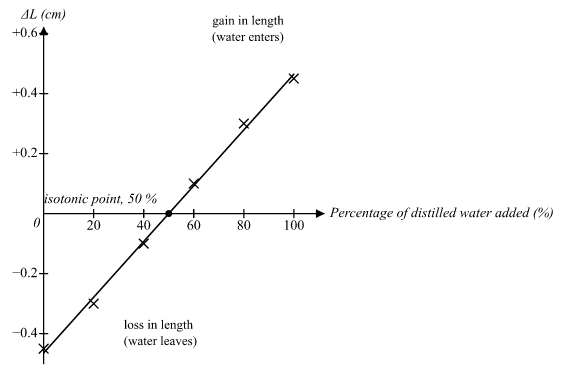
=108×100=80(b)(i) (06 marks)Plot ΔL (cm) on the vertical axis against percentage of distilled water on the horizontal axis
Use a scale that fills most of the grid; the ΔL axis must show negative values; title the graph and label both axes with units
Draw a line of best fit through the points
(b)(ii) (05 marks)Read where the line cuts ΔL = 0: at 50 % distilled water
% solution Q=100−50=50%At this point the cylinder neither gains nor loses length
So there is no net movement of water into or out of the cells
The water potential of the cell sap equals that of the mixture: the mixture is isotonic to the cell sap
Hence a solution of 50 % solution Q by volume has the same concentration as the cell sap of P (sample readings)
(b)(iii) (06 marks)1. ΔL increases steadily as the percentage of distilled water rises from 0 % to 100 %
2. Below 50 % water the mixture is more concentrated (hypertonic, lower water potential) than the cell sap
3. Water leaves the cells by osmosis; vacuoles shrink, cells lose turgor (become flaccid or plasmolysed) and the cylinder shortens (ΔL negative)
4. The lower the percentage of water, the steeper the water potential gradient, so the greater the loss in length (0 % gives the shortest cylinder)
5. At 50 % water the mixture is isotonic: no net osmosis, ΔL = 0
6. Above 50 % the mixture is hypotonic (higher water potential); water enters the cells by osmosis, cells become turgid and the cylinder lengthens; the gain is greatest in distilled water
(c)(i) (05 marks)1. Distilled water has the highest water potential (zero), so water enters the cells of the cylinder in tube A by osmosis
2. As the vacuole swells, the protoplast presses against the cellulose cell wall
3. The cell wall is rigid and only slightly elastic; it presses back with an equal wall pressure (pressure potential rises)
4. When
ψp becomes equal and opposite to
ψs, the water potential of the cell becomes zero, equal to that of distilled water
5. Now water enters and leaves at the same rate (dynamic equilibrium), so there is no net uptake: the cells are fully turgid and cannot stretch further, nor do they burst
Since one hour is enough to reach this equilibrium, the length recorded is the greatest possible
(c)(ii) (04 marks)Soil solution with 37 % water corresponds to 63 % solution Q
This is more concentrated than the cell sap (50 % Q), i.e. the soil solution is hypertonic to the root cells
1. Water would move out of the root hair cells into the soil by osmosis instead of being absorbed
2. The plant would suffer physiological drought even though the soil is moist
3. Its cells would lose turgor and plasmolyse; the leaves wilt, stomata close, photosynthesis and growth stop, and the plant may die
4. So the plant is not adapted to such salty or concentrated soils; it can grow only where the soil solution is less concentrated than its cell sap (above about 50 % water), unlike halophytes that raise the solute concentration of their cell sap
Conclusion: the plant from which P came cannot obtain water from a soil solution of 37 % water and would wilt there
Answer: (b)(ii) about 50 % solution Q (isotonic point, ΔL = 0); (c)(i) the rigid cell wall stops further water entry once the cells are fully turgid; (c)(ii) the soil is hypertonic, so the plant loses water and wilts
Tip: Always draw the ΔL axis through negative values and read the isotonic point where the line crosses ΔL = 0