What we are solvingH and J are composite inflorescences (capitula, family Asteraceae, e.g.
Bidens or
Tridax); I is a grass inflorescence (family Poaceae)
We describe the florets, compare the gynoecium, examine pollen and deduce the mode of pollination,
then draw a longitudinal section of a capitulum
Chapter: Reproduction in flowering plants
Topic: inflorescences, floral structure, pollination
ConceptFlowers pollinated by insects are grouped and showy with sticky spiny pollen; wind-pollinated flowers are small, dull, with light smooth pollen and feathery stigmas
(a)(i) (02 marks)1. Many small sessile florets are crowded together on a flat or slightly convex receptacle (a capitulum), surrounded by a ring of green involucral bracts
2. Ray florets with strap-shaped (ligulate) corollas form the outer ring; tubular disc florets fill the centre
3. The florets open centripetally: the outer ones are the oldest, the youngest are at the centre
(a)(ii) (05 marks)1. Androecium: three stamens with long, slender, thread-like filaments
2. Anthers large, linear, two-lobed, attached at their middle to the filament (versatile), so they swing freely
3. The anthers hang outside the floret, between the lemma and palea
4. Gynoecium: one small superior ovary with one ovule (one locule)
5. Two short styles, each ending in a large feathery (plumose) stigma that projects out of the floret
(b)(i) (04 marks)1. Grouping many small florets into one head makes a large, conspicuous structure that attracts insects from a distance
2. The ligulate ray florets on the margin act like petals of one big flower and form a landing platform
3. One insect visit can pollinate many florets at once, saving pollen, nectar and material for petals
4. Centripetal opening means florets at different stages are present for a long time; with protandry this favours cross-pollination
5. The involucral bracts protect the young florets in the bud
(b)(ii) (03 marks)| Gynoecium of a floret of J (composite) | Gynoecium of a floret of I (grass) |
|---|
| Ovary inferior | Ovary superior |
| One long style | Two short styles |
| Stigma bifid with two short curved, hairy (sweeping) arms | Two large feathery stigmas |
| Stigma pushed up through the anther tube | Stigmas hang outside the floret |
(c)(i) (1½ marks)1. Very many pollen grains, all separate (not in clumps)
2. Small, round (spherical), with a smooth, thin outer wall
3. Dry and powdery, not sticky
(c)(ii) (03 marks)Mode:
wind pollinationReasons:
1. Pollen grains are numerous, small, light, smooth and dry, so they are easily blown by the wind
2. The versatile anthers on long filaments hang outside the floret and shake in the wind, releasing pollen
3. The large feathery stigmas hang outside and give a big surface to trap air-borne pollen
4. The florets are small, green and have no scent or nectar (they do not attract insects)
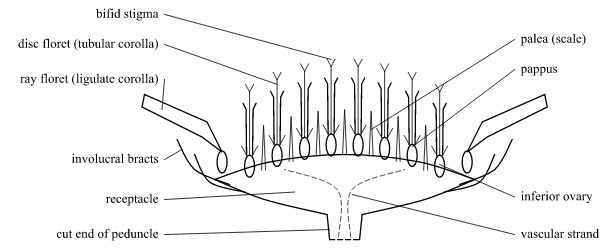
(d) (5½ marks)Cut the peduncle off just below the head; cut the head into two halves through the centre
Shave a thin longitudinal slice from one half, mount it in water and view under low power
Title: L.S. of specimen H (capitulum) as seen under low power
Label: receptacle, involucral bracts, ray florets, disc florets, paleae (scales), pappus, inferior ovary, style and bifid stigma, vascular strands, cut end of peduncle
Answer: J: capitulum of ray and disc florets opening centripetally (attracts insects, one visit pollinates many); I: grass floret with versatile anthers and feathery stigmas, smooth light pollen, wind pollinated; H: L.S. of capitulum as drawn
Tip: Judge the mode of pollination from what you actually see: spiny, sticky, clumped pollen means insect pollination; smooth, dry, separate pollen means wind pollination