What we are solvingExplain why the plasma membrane is partially permeable and why it is called fluid mosaic,
the advantages of membrane-bound organelles, and name two organelles without membranes
Chapter: Cell biology
Topic: membrane structure; eukaryotic organelles
(a)(i) (2 marks)The phospholipid bilayer has a hydrophobic core: small and lipid-soluble molecules pass, ions and large polar molecules cannot
Specific channel and carrier proteins let only certain substances through
So it lets some substances through and not others
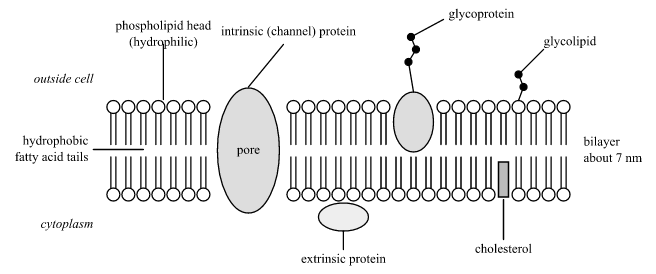
(a)(ii) (3 marks)Fluid: phospholipid molecules and many proteins move sideways within each layer, so the membrane is flexible
Mosaic: proteins (intrinsic and extrinsic) are scattered in the bilayer like pieces of a mosaic
Cholesterol, glycoproteins and glycolipids are also dotted in it, cholesterol controlling the fluidity
(b) (3 marks)Compartmentalisation: incompatible reactions are kept apart (lysosome enzymes kept from the cytoplasm)
Enzymes and substrates are concentrated in one place, so reactions are faster (Krebs cycle in the mitochondrial matrix)
Membranes give a large surface for enzymes and for building up gradients (ATP synthesis on cristae and thylakoids)
Products can be packaged and transported in vesicles (ER and Golgi)
(c) (2 marks)Ribosomes
Centrioles (also: microtubules, nucleolus)
Answer: (a)(i) lipid core + specific proteins let only some substances pass; (ii) moving lipids and proteins (fluid) with scattered proteins (mosaic). (b) separation of reactions, concentrated enzymes, large surface, transport in vesicles. (c) ribosomes, centrioles.