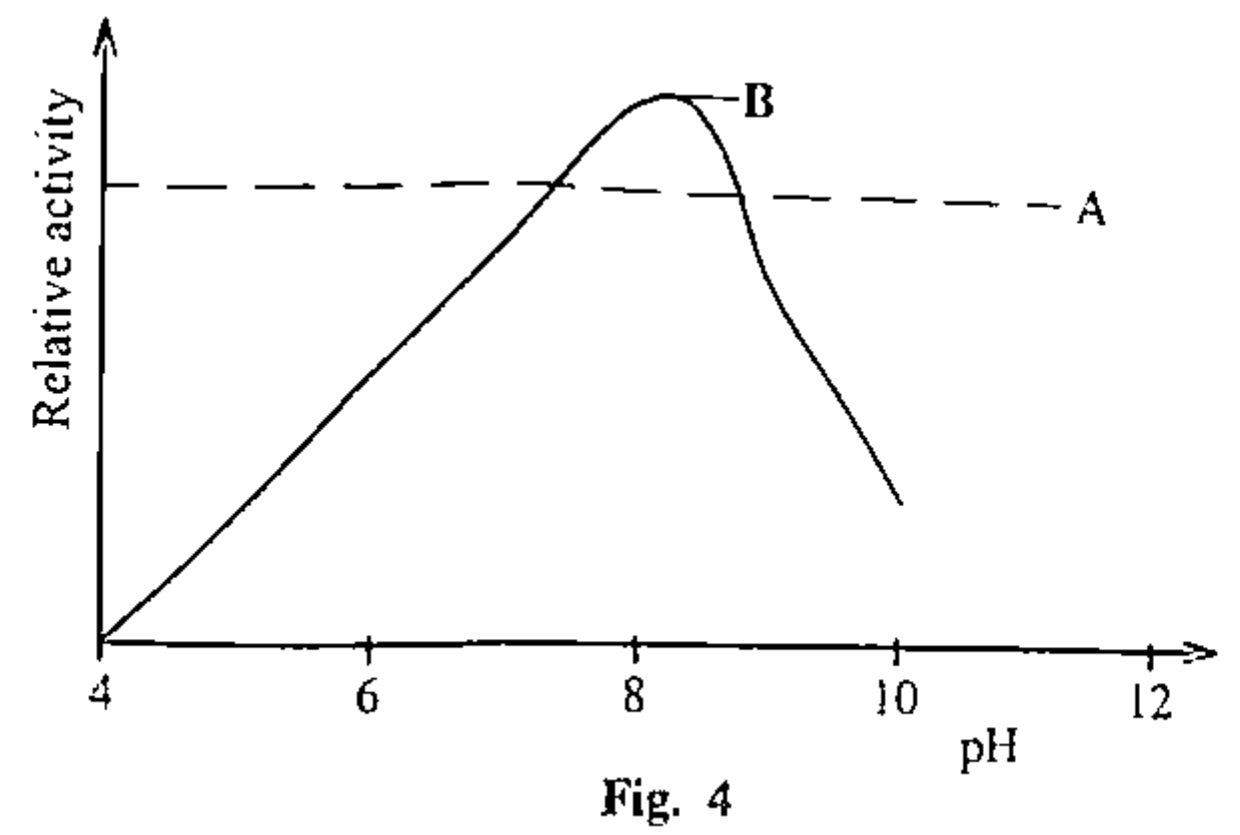
What we are solvingDefine protein denaturation, use Fig. 4 (enzyme A: constant activity at all pH; enzyme B: peaks near pH 8.3)
to compare the enzymes, and explain how inorganic chemicals denature proteins
Chapter: Biochemistry
Topic: proteins and enzymes: effect of pH
(a) (2 marks)A change in the three-dimensional (tertiary) shape of a protein caused by breaking its hydrogen, ionic and disulphide bonds
The protein loses its biological activity (for an enzyme, the active site changes shape); the primary structure is not broken
(b)(i) (2 marks)Enzyme A keeps the same activity at every pH from 4 to 12: it works in acidic, neutral and alkaline places
Its activity is not lowered by small pH changes in the cell, while enzyme B's activity falls sharply away from about pH 8
Below pH 7.5 and above about pH 8.8, A is more active than B
(b)(ii) (3 marks)From pH 4 to about pH 8.3 activity of B rises steadily: closer to the optimum, the ionic charges of the active site suit the substrate better
Optimum pH is about 8.3 (alkaline): B is an alkaline enzyme, e.g. trypsin or lipase in the small intestine
Above pH 8.3 activity falls steeply to pH 10: excess
OH− alters the charges on the active site and denatures the enzyme
B works only over a narrow pH range
(b)(iii) (3 marks)Heavy metal ions (
Hg2+,
Ag+,
Pb2+,
Cu2+) bind to
−SH groups and break disulphide bridges
Strong acids and alkalis (
H+ /
OH−) change the charges on R groups, breaking ionic and hydrogen bonds
Concentrated salts compete for charged groups and water, upsetting ionic bonds
The tertiary shape is lost, so the protein (active site) no longer works
Answer: (a) loss of 3-D shape and function by breaking of weak bonds. (b)(i) A works at all pH 4–12; (ii) B: optimum about pH 8.3, rises then falls sharply, narrow alkaline range. (iii) metal ions break S–S bonds, acids/alkalis break ionic and H bonds.
Tip: Quote pH values from the graph (optimum about 8.3, steep fall to pH 10).