What we are solvingCompare mass flow and cytoplasmic streaming, give conditions for mass flow,
and explain the roles of the endodermis and plasmodesmata in moving substances in plants
Chapter: Transport in plants
Topic: translocation; movement of water and solutes in roots
(a)(i) (2 marks)Mass flow is a passive bulk movement of solution along a pressure gradient; cytoplasmic streaming is an active circulation of cytoplasm using ATP
Mass flow moves solutes in one direction (source to sink); streaming moves substances in many directions (both ways) inside a cell
Mass flow happens between cells (sieve tubes, xylem); streaming happens within a cell
(a)(ii) (3 marks)A difference in hydrostatic (pressure) potential between two places (source and sink)
A source where solutes are loaded, so water enters by osmosis and pressure rises (leaves)
A sink where solutes are removed, lowering pressure (roots, fruits)
A continuous open channel (sieve tubes with perforated sieve plates, or xylem vessels) joining source and sink
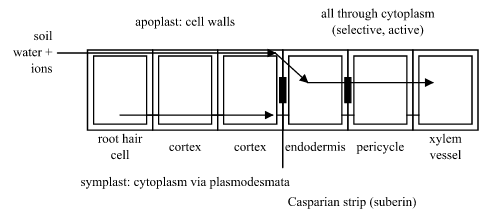
(b)(i) (3 marks)The radial and end walls of endodermal cells carry the Casparian strip of suberin, which is waterproof
It blocks the apoplast (cell wall) route, so water and ions must pass through the cytoplasm of endodermal cells
The membranes select which ions enter and keep out toxic ones
Endodermal cells actively pump ions into the xylem, lowering water potential there and producing root pressure; the strip also stops ions leaking back
(b)(ii) (2 marks)Plasmodesmata are strands of cytoplasm through pores in the cell walls joining neighbouring cells
They make the cytoplasm continuous (symplast), so water, ions and sugars move from cell to cell without crossing walls; in phloem they link companion cells to sieve tubes for loading
Answer: (a)(i) mass flow passive, one-way, between cells; streaming active, many directions, within cells. (ii) pressure gradient, source, sink, continuous channel. (b)(i) Casparian strip forces selective passage through cytoplasm and active ion loading. (ii) symplast links between cells.