Test Index
UACE Biology 2024 Paper 2 (Theory)
© africaexams.com
Question : 3
Total: 6
Solution:
What we are solving(a) Describe the full life cycle of a moss (e.g. Funaria), with its two generations(b) List four problems plants face on landChapter: Diversity of organisms (Bryophyta); plant adaptation to landTopic: alternation of generations in mosses; colonisation of landConcept and formulasMosses show alternation of generations: a haploid (n) gametophyte alternates with a diploid (2n) sporophyteThe gametophyte is dominant and independent; the sporophyte grows on it and depends on itMeiosis happens when spores form; gametes are made by mitosis; fertilisation needs waterWorking(a) (16 marks)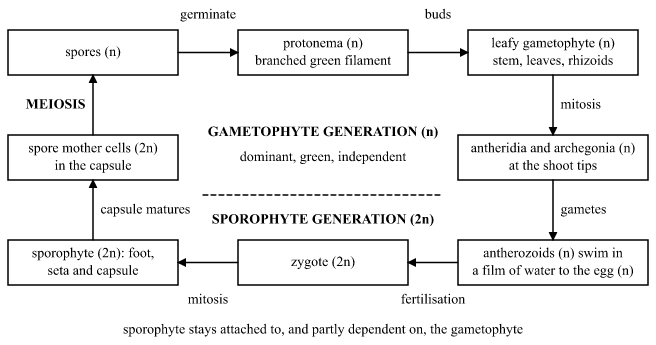 A haploid spore lands on damp soil, rock or bark and germinatesIt grows into a protonema: a branched, green, filamentous structure that photosynthesisesBuds form on the protonema and each grows into a leafy gametophyteThe leafy shoot has a stem-like axis, small spirally arranged leaves and multicellular rhizoids for anchorage and absorptionAt the shoot tips the gametophyte forms sex organs; in Funaria male and female organs are on separate branches of the same plantAntheridia (male) are club-shaped, stalked, mixed with sterile hairs (paraphyses), and surrounded by a rosette of leavesInside each antheridium, cells divide by mitosis to give many biflagellate antherozoids (male gametes, n)Archegonia (female) are flask-shaped, with a long neck of neck canal cells and a swollen venter holding one egg (ovum, n) and a venter canal cellWhen the archegonium is mature, the neck canal cells break down into mucilage that releases chemicals (e.g. sugars) to attract antherozoidsWhen wet (rain or dew), the antheridium bursts and antherozoids swim through a film of water, often carried by rain splashAntherozoids swim down the neck by chemotaxis, and one fuses with the egg in the venter (fertilisation)This gives a diploid zygote, the first cell of the sporophyte generationThe zygote divides by mitosis to form an embryo that grows into the sporophyte while still in the archegoniumThe sporophyte has a foot sunk in the gametophyte to absorb water and nutrients, a long stalk (seta) and a capsule at the topThe young capsule is green and makes some food, but the sporophyte depends on the gametophyte for water and mineralsThe venter wall grows to form the calyptra, a hood that protects the young capsuleInside the capsule, spore mother cells (2n) divide by meiosis to form haploid sporesAt maturity the calyptra falls off; the capsule dries and the lid (operculum) comes offA ring of hygroscopic peristome teeth opens in dry weather and closes in wet weather, so spores are released slowly in dry conditionsLight spores are dispersed by wind and germinate into new protonemata, completing the cycleMosses also reproduce vegetatively, by fragmentation of the protonema and by gemmae(b) (4 marks)Water loss by evaporation, which can dry out (desiccate) the plantLack of support against gravity, since air gives no buoyancyGetting water and minerals from the soil and carrying them to all parts of the plantFertilisation without water in which male gametes can swimGaseous exchange surfaces must be moist, but this also causes water lossWide changes in temperature and exposure of the embryo and spores to dryingAnswer: (a) Spore (n) → protonema → leafy gametophyte → antheridia and archegonia → antherozoids swim in water to the egg → zygote (2n) → sporophyte (foot, seta, capsule) → meiosis → spores. (b) Water loss, support, water uptake and transport, fertilisation without water.Tip: Always mark n and 2n and say where meiosis happens; examiners look for this.
© africaexams.com
Go to Question:
Advertisements