Test Index
UACE Biology 2024 Paper 2 (Theory)
© africaexams.com
Question : 2
Total: 6
Solution:
What we are solving(a) Link each structural feature of the mitochondrion to its job of aerobic respiration(b) Explain how reduced NAD is used to make ATP (oxidative phosphorylation)Chapter: Cell biology and respirationTopic: mitochondrion structure; electron transport chain and chemiosmosisConcept and formulasThe mitochondrion is the site of the link reaction, the Krebs cycle (matrix) and oxidative phosphorylation (inner membrane)Oxidative phosphorylation works by chemiosmosis (Mitchell): electron flow pumps protons, and the proton flow back drives ATP synthaseNADH+H++21O2→NAD++H2OADP+Pi→ATPWorking(a) (12 marks)Labelled mitochondrion: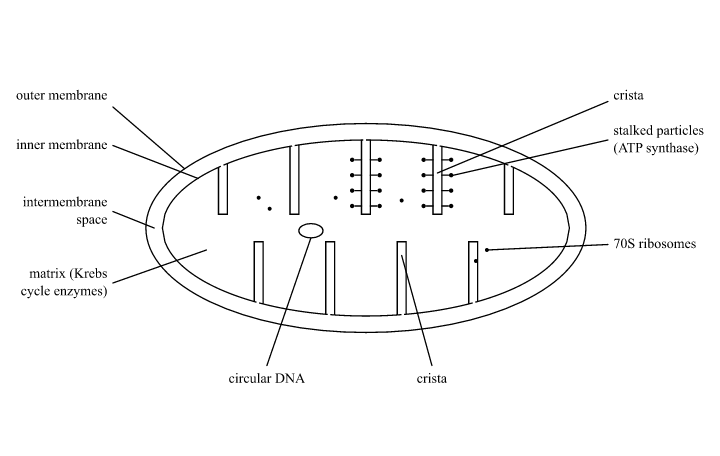 It has a double membrane (envelope), which keeps the respiratory enzymes and reactions apart from the cytoplasmThe outer membrane is smooth and permeable (has porins), so pyruvate, oxygen, ADP and phosphate enter easilyThe inner membrane is folded into cristae, giving a large surface area for the electron carriers and ATP synthaseActive cells (e.g. muscle, sperm) have mitochondria with more, densely packed cristae, so they make more ATPThe inner membrane carries the electron transport chain (NADH dehydrogenase, ubiquinone, cytochromes) in a fixed order for stepwise release of energyThe inner membrane bears stalked particles (ATP synthase) where ADP is phosphorylated to ATPThe inner membrane is impermeable to protons, so a proton gradient can build up across itThe intermembrane space is narrow, so pumped protons quickly reach a high concentration (steep gradient)The inner membrane has carrier proteins that move pyruvate into, and ATP out of, the matrixThe matrix contains the enzymes of the link reaction and Krebs cycle, which produce reduced NAD and reduced FADThe matrix contains coenzymes (NAD, FAD, coenzyme A) needed by these enzymesThe matrix has its own circular DNA and 70S ribosomes, so it makes some of its own proteins and can divide (self-replicate) when the cell needs more ATPIts small, elongated shape gives a large surface area to volume ratio for rapid exchange of materialsMany mitochondria lie close to where energy is used (e.g. between muscle fibrils, in the sperm middle piece)(b) (8 marks)Here "NAD" means reduced NAD (NADH + H+) made in glycolysis, the link reaction and the Krebs cycle
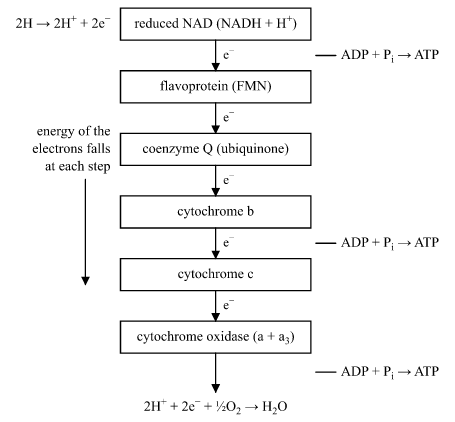 Reduced NAD passes its hydrogen to the first carrier (flavoprotein, FMN) on the inner membrane; NAD is regeneratedThe hydrogen atoms split into protons (H+) and electrons (e−)The electrons pass along a chain of carriers (coenzyme Q, cytochromes b, c, a and a3), each at a lower energy levelEach carrier is reduced on receiving electrons and oxidised when it passes them on (redox reactions)Energy released at three points is used to pump protons from the matrix into the intermembrane spaceThis builds a proton (electrochemical) gradient across the inner membraneProtons diffuse back into the matrix through ATP synthase (stalked particles), and this flow drives ADP+Pi→ATP (chemiosmosis)Oxygen is the final electron acceptor: cytochrome oxidase combines electrons, protons and oxygen to form waterEach reduced NAD gives 3 ATP (reduced FAD, which enters lower down the chain, gives 2)Answer: (a) Double membrane, cristae with large surface area, ETC and stalked particles on the inner membrane, proton-tight inner membrane, narrow intermembrane space, enzyme-rich matrix, own DNA and ribosomes. (b) Electrons from reduced NAD pass along the ETC, protons are pumped, and the proton flow back through ATP synthase makes 3 ATP per reduced NAD, with oxygen forming water.Tip: In "how is the structure suited" answers, give each feature with its function in the same sentence.
© africaexams.com
Go to Question:
Advertisements