Test Index
UACE Biology 2024 Paper 2 (Theory)
© africaexams.com
Question : 5
Total: 6
Solution:
What we are solving(a) Give the similarities and differences in gaseous exchange and ventilation between bony fish (e.g. tilapia, Nile perch) and cartilaginous fish (e.g. dogfish, shark)(b) Describe how the rate and depth of breathing in mammals are controlledChapter: Gaseous exchangeTopic: gills and ventilation in fish; control of breathing in mammalsConcept and formulasA "compare" answer needs both similarities and differencesFish ventilate by changing the volume, and so the pressure, of the mouth (buccal) cavity; water flows from high to low pressureOxygen diffuses from water into blood down a concentration gradient across thin gill lamellaeIn mammals breathing is set by the respiratory centre in the medulla, adjusted mainly by the carbon dioxide levelWorking(a) (12 marks)SimilaritiesBoth use gills as the gaseous exchange surface, with water as the mediumIn both, gills have many filaments and secondary lamellae, giving a large surface areaIn both, the lamellae have a thin epithelium and a dense capillary network, so the diffusion distance is shortIn both, water flows in one direction: in at the mouth and out over the gillsIn both, ventilation is by muscles raising and lowering the floor of the mouth, changing volume and pressureIn both, oxygen diffuses into the blood and carbon dioxide diffuses out into the waterDifferences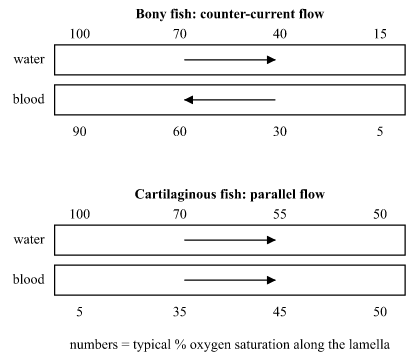
Ventilation in bony fishInspiration: the mouth opens and the floor of the buccal cavity is lowered; its volume rises and pressure falls, so water entersAt the same time the operculum bulges out with its valve closed; the opercular cavity expands and its pressure falls below the buccal pressure, so water is drawn over the gillsExpiration: the mouth closes and the buccal floor is raised; pressure rises and water is forced over the gillsThe operculum moves in, the opercular valve opens, and water leavesVentilation in cartilaginous fishInspiration: the mouth and spiracles open and the floor of the bucco-pharyngeal cavity is lowered; pressure falls and water entersThe gill slit flaps are pressed shut by water pressure outsideExpiration: the mouth closes and the floor is raised; pressure rises, water is forced over the gills into the parabranchial cavities and out through the gill slits, pushing the flaps open(b) (8 marks)The respiratory centre in the medulla oblongata has an inspiratory centre and an expiratory centre; centres in the pons fine-tune the rhythmThe inspiratory centre sends impulses along the phrenic nerves to the diaphragm and the intercostal nerves to the external intercostal musclesThese muscles contract, the thorax enlarges and air is drawn in (inspiration)As the lungs inflate, stretch receptors in the bronchiole walls send impulses along the vagus nerve to the expiratory centreThe expiratory centre inhibits the inspiratory centre, the muscles relax, and expiration follows by elastic recoil (Hering-Breuer reflex)As the lungs deflate the stretch receptors stop firing, the inspiratory centre is released again, and a rhythm is set upChemical control: a rise in blood CO2 forms carbonic acid, so H+ rises and pH fallsCentral chemoreceptors in the medulla and peripheral chemoreceptors in the carotid and aortic bodies detect thisThey send impulses to the respiratory centre, which increases the rate and depth of breathing until the excess CO2 is removedA large fall in blood O2 (e.g. at high altitude) also stimulates the carotid and aortic bodies to increase breathingThe cerebral cortex gives voluntary control, e.g. holding the breath, speaking or singingAnswer: (a) Both use gills with a large, thin, well-supplied surface and a buccal pump; bony fish have an operculum, an opercular pump and counter-current flow, while cartilaginous fish have gill slits, spiracles and mainly parallel flow. (b) Breathing is controlled by the respiratory centre in the medulla through stretch receptors (vagus) and chemoreceptors sensitive mainly to CO2.Tip: In "compare" questions, give similarities first, then differences in a two-column table.
| Bony fish | Cartilaginous fish |
|---|---|
| Gills covered by a bony operculum, one opening on each side | No operculum; five to seven separate gill slits on each side |
| No spiracle | A spiracle (first gill slit) behind each eye takes in water |
| Counter-current flow: water and blood flow in opposite directions | Mainly parallel flow: water and blood flow in the same direction |
| A diffusion gradient is kept along the whole lamella, so up to about 80% of the oxygen is taken up | Water and blood reach equilibrium part way, so only about 50% of the oxygen is taken up |
| Gill septum short; filament tips free | Gill septum long, reaching the body surface as a flap over the next slit |
| Gill arches made of bone | Gill arches made of cartilage |
| Buccal pump and opercular suction pump work together | Buccal (bucco-pharyngeal) pump only; many sharks also use ram ventilation by swimming with the mouth open |
| Water flows over the gills almost continuously | Water flow is more intermittent |
© africaexams.com
Go to Question:
Advertisements