Test Index
UACE Biology 2024 Paper 2 (Theory)
© africaexams.com
Question : 6
Total: 6
Solution:
What we are solving(a) Describe the structure of a chloroplast(b) Outline how sucrose is made in a C4 plant (e.g. maize, sugarcane, sorghum)(c) Explain why C3 and C4 plants are found in different temperature and altitude zonesChapter: Nutrition (photosynthesis)Topic: chloroplast; C4 (Hatch-Slack) pathway; photorespirationConcept and formulasLight-dependent reactions on the thylakoids make ATP and NADPH; the Calvin cycle in the stroma uses them to fix CO2RuBisCO also reacts with oxygen (photorespiration), which wastes fixed carbon, especially at high temperaturesC4 plants first fix CO2 with PEP carboxylase, which does not react with O2, and then release it at high concentration around RuBisCOPEP (3C)+CO2PEP carboxylaseoxaloacetate (4C)RuBP (5C)+CO2RuBisCO2 GP (3C)Working(a) (7 marks)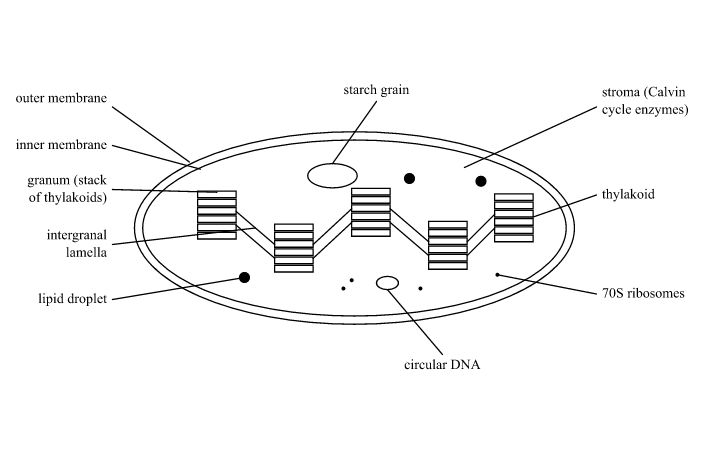 A chloroplast is a lens-shaped (biconvex) organelle about 2 to 10 µm longIt is bounded by an envelope of two membranes, outer and inner, with a narrow space betweenInside is the stroma, a colourless gel holding the Calvin cycle enzymes (e.g. RuBisCO)Running through the stroma is a system of membranes: flattened sacs called thylakoidsIn places thylakoids are stacked like coins to form granaGrana are joined to each other by unstacked intergranal (stroma) lamellaeThe thylakoid membranes carry the photosynthetic pigments (chlorophyll a, chlorophyll b, carotenoids) in photosystems I and II, electron carriers and ATP synthaseThe stroma also holds starch grains, lipid droplets, circular DNA and 70S ribosomesIn C4 plants, mesophyll chloroplasts have grana, but bundle sheath chloroplasts have few or no grana and large starch grains(b) (7 marks)
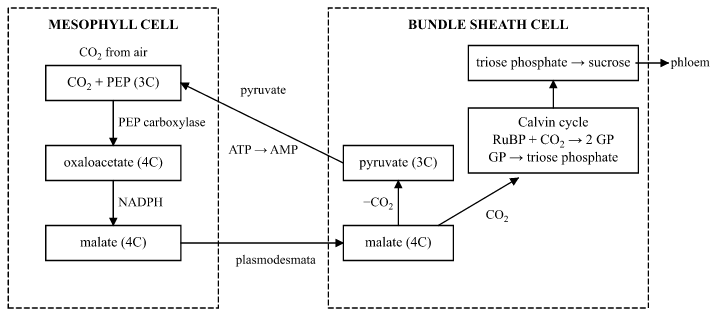 In mesophyll cells, CO2 (as hydrogencarbonate) combines with phosphoenolpyruvate (PEP, 3C), catalysed by PEP carboxylase, to form oxaloacetate (4C)Oxaloacetate is reduced by NADPH to malate (4C) (in some species it is changed to aspartate)Malate passes through plasmodesmata into the bundle sheath cellsThere malate is decarboxylated, releasing CO2 and pyruvate (3C) and regenerating NADPHThe CO2 enters the Calvin cycle: it combines with RuBP (5C), using RuBisCO, to form two molecules of glycerate-3-phosphate (GP)GP is reduced by ATP and NADPH to triose phosphate; most of it regenerates RuBP using ATPSome triose phosphate passes to the cytoplasm and is converted to fructose-6-phosphate and glucose-1-phosphateGlucose-1-phosphate reacts with UTP to give UDP-glucose; UDP-glucose and fructose-6-phosphate join to form sucrose (via sucrose phosphate)Sucrose is loaded into the phloem and carried to other parts of the plantPyruvate returns to the mesophyll and is converted back to PEP using ATP (ATP → AMP), ready to accept more CO2(c) (6 marks)TemperatureAt high temperatures RuBisCO binds oxygen more readily, and CO2 becomes less soluble compared with O2, so photorespiration rises in C3 plants and their yield fallsC4 plants concentrate CO2 in the bundle sheath, so photorespiration is almost nil; their enzymes also work best at about 30 to 45 °CC4 plants can also partly close their stomata in hot, dry weather and still fix CO2, saving waterSo C4 plants dominate hot, sunny, low-altitude areas, e.g. maize, sorghum, sugarcane and elephant grass in the lowland savanna of UgandaAltitudeTemperature falls with altitude, so photorespiration is low in cool highlands and C3 plants grow well thereThe C4 pathway costs extra ATP for each CO2 fixed, and some of its enzymes (e.g. pyruvate phosphate dikinase) are damaged by cold, so it gives no advantage at low temperaturesSo C3 plants dominate cool, high-altitude areas, e.g. wheat, Irish potatoes and Arabica coffee on Mt Elgon and in KigeziAnswer: (a) Double-membrane envelope, stroma with enzymes, thylakoids stacked into grana joined by intergranal lamellae, pigments on thylakoids, starch, lipid, DNA and ribosomes. (b) CO2 + PEP → oxaloacetate → malate in the mesophyll; malate → CO2 + pyruvate in the bundle sheath; Calvin cycle → triose phosphate → sucrose. (c) C4 plants are favoured in hot lowlands (no photorespiration); C3 plants in cool highlands.Tip: Always give the number of carbon atoms (3C, 4C, 5C) for each compound in C4 pathway answers.
© africaexams.com
Go to Question:
Advertisements