What we are solvingHow a mango tree and a grasshopper get a large gas exchange surface
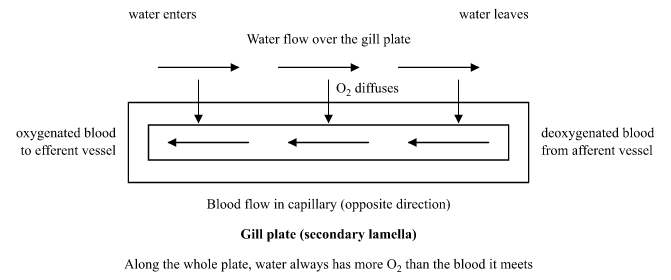
Then the counter current flow over the gills of a bony fish (e.g. tilapia): draw it, explain it, and compare with parallel flow
Chapter: Gaseous exchange
Topic: respiratory surfaces: plants, insects, fish gills
(a)(i) Mango tree (2 marks)1. Many broad, thin, flat leaves give a large surface with many stomata
2. Spongy mesophyll has large intercellular air spaces, so a large moist internal surface is exposed
3. Many lenticels on the stem and roots
(a)(ii) Grasshopper (1 mark)The tracheae branch into very many fine tracheoles that reach every tissue, giving a very large surface (air sacs add more)
(b)(i) Drawing (2 marks)Water flows over the gill plate in one direction; blood in the capillaries flows in the opposite direction
Labels needed: gill plate (lamella), direction of water flow, direction of blood flow, oxygen diffusing into the blood
(b)(ii) (3 marks)1. Water and blood flow in opposite directions
2. Blood at each point meets water that has more oxygen than it has
3. So a diffusion gradient is kept along the whole length of the gill plate
4. Oxygen diffuses into the blood all the way along, so blood leaves almost as oxygen-rich as the incoming water and most of the oxygen is extracted
(b)(iii) (2 marks)1. Blood and water would quickly reach the same oxygen concentration (equilibrium) part way along the plate
2. After that point no more oxygen diffuses in, so the blood would be at most about half saturated and gas exchange would be much less efficient
Answer: (a) mango: broad thin leaves, air spaces, lenticels; grasshopper: numerous tracheoles. (b) Opposite flow keeps a concentration gradient along the whole plate; parallel flow reaches equilibrium and stops diffusion early.
Tip: In a counter current answer always say 'diffusion gradient maintained along the whole length'.