What we are solvingChromosome mutations: definition, a chemical cause, how polyploidy and non-disjunction arise, and why they can be useful
Chapter: Genetics and evolution
Topic: variation: chromosome mutations
(a)(i) (1 mark)A chromosome mutation is a change in the structure or in the number of chromosomes in a cell
(a)(ii) (1 mark)Colchicine (also mustard gas)
(b)(i) Polyploidy (3 marks)1. Chromosomes replicate but the spindle fails to form or the cell fails to divide (e.g. due to sudden cold or colchicine)
2. A gamete or cell then has two full sets (2n) instead of one
3. A 2n gamete fusing with a normal n gamete gives a triploid (3n); two 2n gametes give a tetraploid (4n) (autopolyploidy)
4. In a sterile hybrid of two species, doubling of the chromosome number gives fertile allopolyploids (e.g. bread wheat)
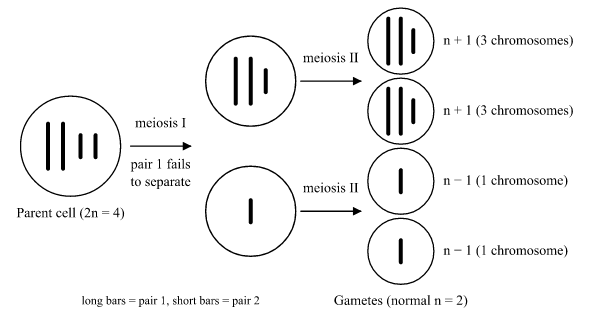
(b)(ii) Non-disjunction (3 marks)1. In anaphase I, a pair of homologous chromosomes fails to separate (or sister chromatids fail to separate in anaphase II)
2. Both chromosomes go to the same pole, so gametes get one extra chromosome (n + 1) or one less (n − 1)
3. Fertilisation with a normal gamete gives 2n + 1 (trisomy, e.g. Down's syndrome, three copies of chromosome 21) or 2n − 1 (monosomy, e.g. Turner's syndrome, XO)
(c) (2 marks)Any two:
1. Polyploid plants are larger and more vigorous with higher yields (e.g. triploid bananas, matooke, and hexaploid wheat)
2. Triploids give seedless fruits
3. They give new variation for natural selection and can form new species
4. Allopolyploidy makes sterile hybrids fertile
Answer: (a) change in chromosome structure or number; colchicine. (b) polyploidy: failure of cell division after replication; non-disjunction: homologues or chromatids fail to separate, giving n + 1 and n − 1 gametes. (c) vigour/yield, seedless fruits, variation, new species.
Tip: Name an example syndrome for non-disjunction: it often earns the last mark.