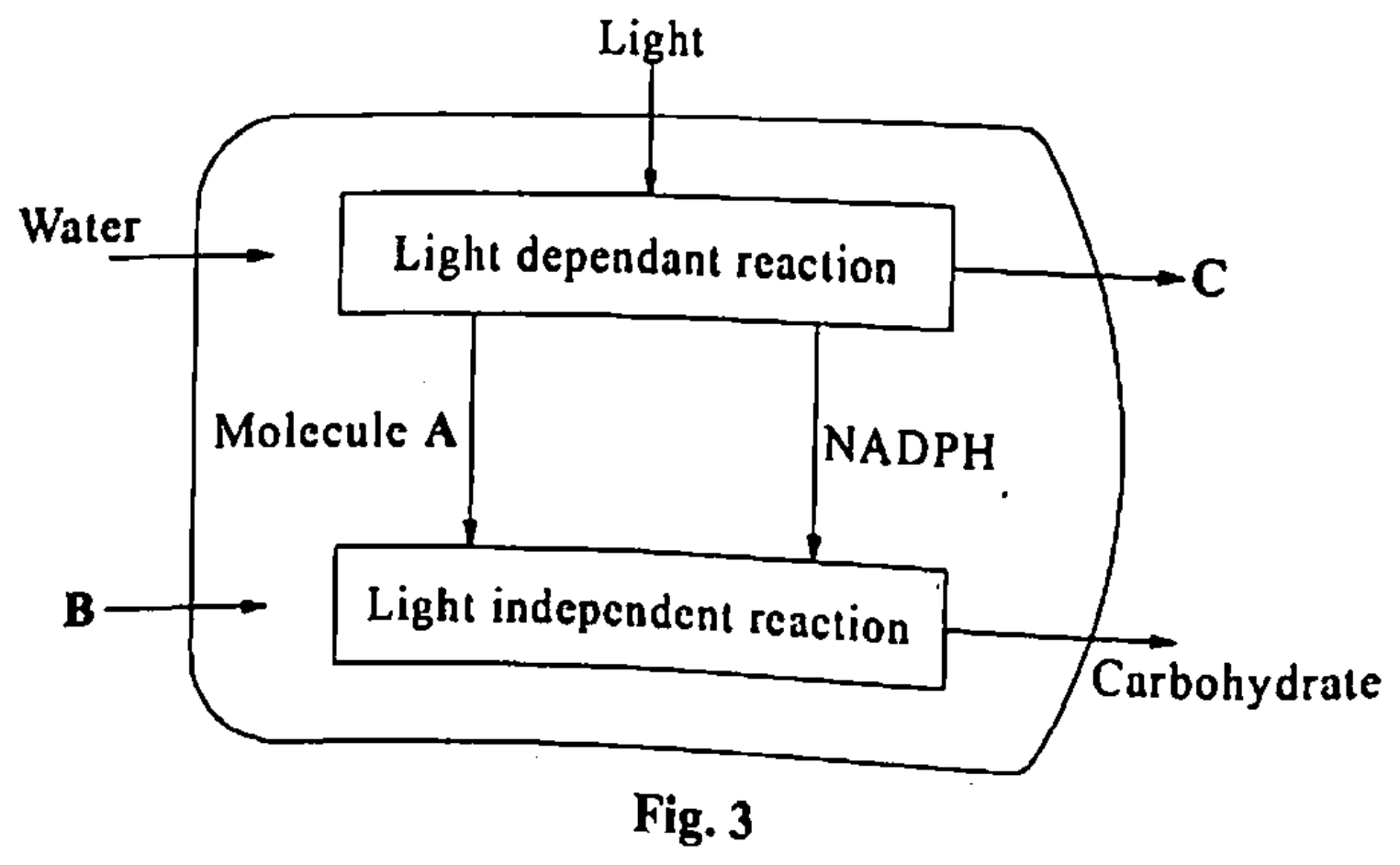
What we are solvingFig. 3 shows the light-dependent and light-independent reactions of photosynthesis
Name A and C, explain how NADPH is made and used, and compare
C3 and
C4 plants
Chapter: Nutrition
Topic: photosynthesis: light reactions, Calvin cycle, C3 and C4 plants
(a) (1 mark)A: ATP (made by photophosphorylation and passed with NADPH to the light-independent reaction)
C: oxygen, from photolysis of water
(B, entering the light-independent reaction, is carbon dioxide)
(b)(i) (2 marks)1. Light excites electrons in chlorophyll of photosystem II and photosystem I; the electrons pass along an electron transport chain
2. Water is split by photolysis:
2H2O→4H++4e−+O23. Excited electrons from photosystem I (via ferredoxin) and
H+ from water reduce
NADP+ to NADPH, catalysed by NADP reductase
(b)(ii) (1 mark)NADPH supplies the hydrogen (reducing power) that, with ATP, reduces glycerate 3-phosphate to triose phosphate in the Calvin cycle
(c)(i) (3 marks)C4 pathway is more efficient
1. In
C3 plants rubisco also binds oxygen; when
O2 is high and
CO2 low it acts as an oxygenase, causing photorespiration that wastes fixed carbon
2.
C4 plants first fix
CO2 with PEP carboxylase, which has a high affinity for
CO2 and does not react with
O23. The
C4 acid (malate) carries the
CO2 to the bundle sheath cells, where it is released at a high concentration around rubisco, so photorespiration is suppressed
(c)(ii) (3 marks)C4 pathway is more efficient (e.g. maize, sugarcane rather than beans)
1. With stomata closed,
CO2 inside the leaf falls and
O2 from photosynthesis builds up
2. High temperature increases rubisco's oxygenase activity, so
C3 plants lose much carbon to photorespiration
3. PEP carboxylase still fixes the low
CO2 efficiently and
CO2 is concentrated in the bundle sheath (Kranz anatomy), so
C4 plants keep photosynthesising with less water loss
Answer: (a) A = ATP, C = oxygen. (b) NADP is reduced by electrons from photosystem I and H⁺ from photolysis; NADPH reduces GP to triose phosphate. (c) C₄ in both cases: PEP carboxylase concentrates CO₂ and avoids photorespiration.
Tip: For any C₃/C₄ question, the key words are 'photorespiration' and 'PEP carboxylase has a high affinity for CO₂'.