What we are solvingCompare two counter current systems, explain how counter current heat exchange saves heat, and give two physiological ways endotherms stay warm in the cold
Chapter: Homeostasis
Topic: temperature regulation and counter current systems
(a) (2 marks)Any two:
1. Counter current multiplier moves solutes (Na⁺, Cl⁻); counter current heat exchange moves heat
2. The multiplier uses energy (active transport of ions); heat exchange is passive (conduction)
3. The multiplier builds up (multiplies) a concentration gradient in the medulla; heat exchange keeps heat in the body core
4. The multiplier is in the loop of Henle of the kidney; heat exchange is in limbs, flippers and fins
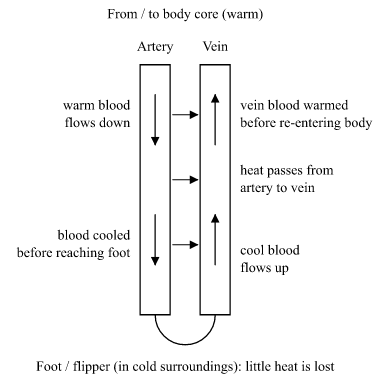
(b) (4 marks)1. Arteries carrying warm blood to the limb run close and parallel to veins carrying cold blood back, in opposite directions
2. Heat is conducted from the warm arterial blood to the cooler venous blood along the whole length
3. Arterial blood is already cooled when it reaches the extremity, so the temperature gradient between limb and surroundings is small and little heat is lost
4. Venous blood is warmed before it enters the body core, so core temperature is kept (e.g. legs of wading birds, flippers of whales)
(c) (4 marks)Any two, each explained:
1. Vasoconstriction: arterioles to the skin constrict, so less blood flows near the surface and less heat is lost by radiation, convection and conduction
2. Shivering: rapid involuntary contractions of skeletal muscles increase respiration, which releases heat
3. Raised metabolic rate: more thyroxine and adrenaline increase respiration in cells (and brown fat), producing more heat
4. Hair erection: erector muscles raise hairs or feathers, trapping a thick layer of still air that insulates the body
Answer: (a) multiplier moves solutes actively in the kidney, heat exchanger moves heat passively in limbs. (b) warm arterial blood gives heat to returning venous blood, so the extremity is cool and loses little heat. (c) vasoconstriction, shivering (or raised metabolism, hair erection).
Tip: 'Explain' in (c) needs the mechanism AND the result for each way.