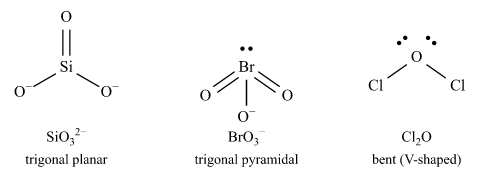
What we are solvingThree species:
SiO32−,
BrO3− and
Cl2OFor each we draw the structure and name the shape
Chapter: Chemical bonding and structure
Topic: shapes of molecules and ions (VSEPR theory)
Concept and formulasElectron pairs round the central atom repel and get as far apart as possible
A double bond counts as one bonding region
The shape is named from the atoms only; lone pairs are not part of the name
3 bonding regions, 0 lone pairs: trigonal planar (120°)
3 bonding regions, 1 lone pair: trigonal pyramidal (about 107°)
2 bonding regions, 2 lone pairs: bent or V-shaped (about 104°–111°)
WorkingTable 1 (4½ marks)SiO32−: Si has 4 valence electrons
It forms one Si=O and two Si–O⁻ bonds, so it has no lone pair
3 bonding regions, no lone pair:
trigonal planarBrO3−: Br has 7 valence electrons, plus 1 from the charge
It forms two Br=O and one Br–O⁻ bond and keeps one lone pair
3 bonding regions, 1 lone pair:
trigonal pyramidalCl2O: O has 6 valence electrons
Two are used in the two O–Cl bonds; the other four form two lone pairs
2 bonding pairs, 2 lone pairs:
bent (V-shaped)Answer: SiO32− trigonal planar;
BrO3− trigonal pyramidal;
Cl2O bent (V-shaped)
Tip: Always show the lone pairs on the central atom in the drawing; they decide the shape