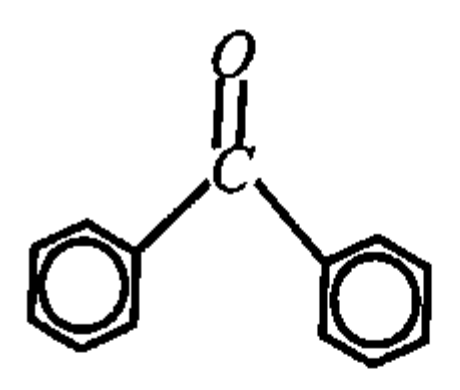
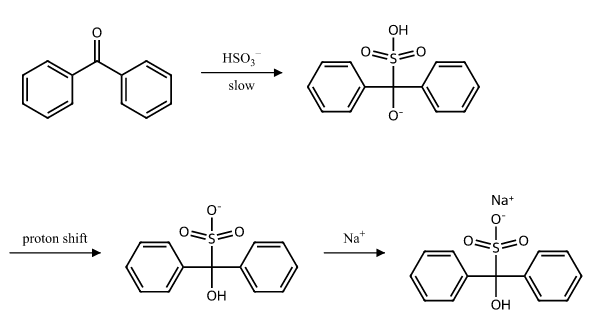
What we are solving(a) Benzophenone reacts with sodium hydrogensulphite(b) Benzene reacts with ethanoyl chloride and aluminium chlorideFor each we write the product and the mechanismChapter: Organic chemistry (carbonyl compounds; aromatic hydrocarbons)Topic: nucleophilic addition to C=O; electrophilic substitution of benzeneConcept and formulasThe C=O carbon is electron-poor (Cδ+=Oδ−), so nucleophiles add to itBenzene is electron-rich and is attacked by electrophiles; the ring keeps its stability by losing H+ (substitution, not addition)AlCl3 is a Lewis acid: it pulls Cl− off the acid chloride and makes the electrophile CH3C+=OWorking(a)(03 marks)Equation:(C6H5)2C=O+NaHSO3⟶(C6H5)2C(OH)SO3−Na+Mechanism:Step 1: the salt ionisesNaHSO3⟶Na++HSO3−Step 2: the lone pair on S of HSO3− attacks the carbonyl carbon; the π electrons of C=O move onto OStep 3: a proton moves from the SO3H group to the O− (proton shift)Step 4: the sulphonate ion pairs with Na+ to give the addition compound
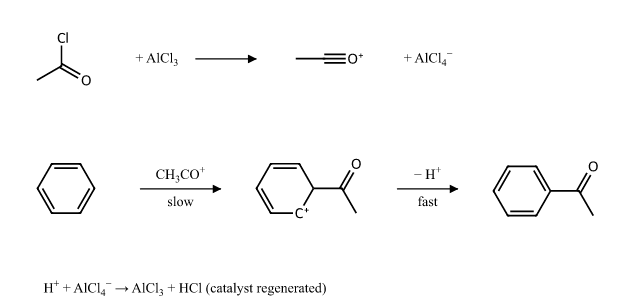
(b)(03 marks)Equation:C6H6+CH3COClAlCl3C6H5COCH3+HClProduct: phenylethanone (acetophenone)Mechanism:Step 1: formation of the electrophileCH3COCl+AlCl3⟶CH3C+=O+AlCl4−Step 2: the π electrons of benzene attack CH3C+=O to form a carbocation (arenium ion); this step is slowStep 3: AlCl4− removes H+ from the carbon carrying the acyl group, restoring the aromatic ringH++AlCl4−⟶AlCl3+HClThe catalyst is regenerated
Answer: (a) (C6H5)2C(OH)SO3−Na+ by nucleophilic addition; (b) C6H5COCH3+HCl by electrophilic substitutionTip: In mechanisms, curly arrows start at a lone pair or a bond and end at the atom that receives the electrons