What we are solvingDefine three energy terms, explain why the second ionisation energy is larger, and describe an experiment for the enthalpy of neutralisation
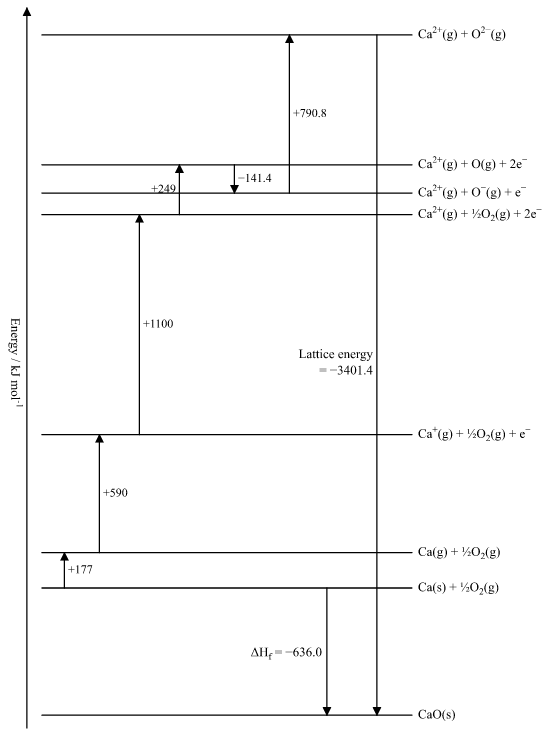
Use the printed data to draw the Born–Haber cycle for CaO and calculate its lattice energy
Use Table 4 to find the enthalpies of solution of LiCl and NaCl and decide which dissolves more on heating
Chapter: Chemical energetics (thermochemistry)
Topic: ionisation energy, electron affinity, Born–Haber cycle, enthalpy of solution
Concept and formulasHess's law: the total enthalpy change is the same whatever the route
Born–Haber:
ΔHf=ΔHsub+IE1+IE2+21BDE+EA1+EA2+LEEnthalpy of solution:
ΔHsol=−LE+ΔHhyd (lattice broken, then ions hydrated)
Heat change:
q=mcΔT(a)(i) (01 mark)Electron affinity is the enthalpy change when one mole of electrons is added to one mole of gaseous atoms to form one mole of gaseous negative ions:
X(g)+e−→X−(g).
(a)(ii) (01 mark)First ionisation energy is the minimum energy required to remove one mole of electrons from one mole of gaseous atoms to form one mole of gaseous unipositive ions:
M(g)→M+(g)+e−.
(a)(iii) (01 mark)Enthalpy of solution is the heat change when one mole of a substance is completely dissolved in so much solvent that further dilution causes no further heat change.
(b) (02 marks)After the first electron is removed, the same nuclear charge holds fewer electrons, so the electron–electron repulsion falls and the ion is smaller.
The remaining electrons are held more tightly, and the second electron must be removed from a positive ion against a greater attraction, so more energy is needed.
(c) (05 marks)Measure
50 cm3 of 2 M hydrochloric acid into a plastic (expanded polystyrene) cup and record its steady temperature,
T1.
Measure
50 cm3 of 2 M sodium hydroxide solution into another cup and record its steady temperature,
T2; the initial temperature is
T0=21(T1+T2).
Quickly add the alkali to the acid, stir with the thermometer and record the highest temperature reached,
T3.
Heat evolved:
q=mc(T3−T0) with
m=100 g (density
1 g cm−3) and
c=4.2 J g−1K−1.
Moles of water formed
=10002×50=0.1 mol, from
H+(aq)+OH−(aq)→H2O(l).
ΔHneut=−0.1×1000100×4.2×(T3−T0) kJ mol−1Assumptions: no heat is lost to the surroundings, and the solution has the density and specific heat capacity of water.
(d)(i) (04 marks)Each step, from
Ca(s)+21O2(g) up to the gaseous ions and then down to
CaO(s) (values in
kJ mol−1;
21×498.0=+249.0 for one mole of O atoms):
(d)(ii) (02 marks)Sum of the steps from the elements to the gaseous ions:
177.0+590.0+1100.0+249.0−141.4+790.8=+2765.4 kJ mol−1By Hess's law,
ΔHf=2765.4+LE:
LE=−636.0−2765.4=−3401.4 kJ mol−1(d)(iii) (01 mark)The lattice energy is very large and negative (and
ΔHf is negative), so calcium oxide is very stable: it has strong ionic bonding between the small, doubly charged
Ca2+ and
O2− ions and a very high melting point.
(e)(i) (1½ marks)The table gives magnitudes: lattice energy (formation of the solid from gaseous ions) and hydration energy are both exothermic, so
LE(LiCl)=−843,
ΔHhyd=−883 kJ mol−1, and so on.
Dissolving = breaking the lattice (
−LE) + hydrating the ions (
ΔHhyd):
ΔHsol(LiCl)=+843+(−883)=−40 kJ mol−1ΔHsol(NaCl)=+778+(−775)=+3 kJ mol−1(e)(ii) (1½ marks)Sodium chloride: its enthalpy of solution is positive (endothermic).
For
NaCl(s)⇌Na+(aq)+Cl−(aq), raising the temperature shifts the equilibrium in the endothermic direction (Le Chatelier), so more NaCl dissolves.
LiCl dissolves exothermically, so heating does not increase (it tends to decrease) its solubility.
Answer: lattice energy of CaO
=−3401.4 kJ mol−1 (very stable);
ΔHsol: LiCl
=−40, NaCl
=+3 kJ mol−1; NaCl dissolves more on heating
Tip: In a Born–Haber cycle use half the O=O bond energy, because CaO contains one O atom.