What we are solvingExplain five observations with reasons and equations
Chapter: Organic chemistry (alcohols, phenols), ionic equilibria, chemical bonding
Topic: carbocation stability, acidity, common ion effect, hydrogen bonding, VSEPR shapes
Concept and formulasCarbocation stability: tertiary > secondary > primary (+I effect of alkyl groups)
Acid strength depends on how stable the anion is
A precipitate forms only when the ionic product exceeds
KspVSEPR: electron pairs round the central atom repel to be as far apart as possible
(a) (2½ marks)The reaction goes through a carbocation (S
N1): the OH is protonated and leaves as water.
R–OH+H+→R–OH2+→R++H2O, then
R++X−→R–XA tertiary carbocation has three electron-releasing (+I) alkyl groups that spread the positive charge, so it is the most stable and forms fastest; a secondary one has two, a primary one only one.
Example:
(CH3)3COH+HCl→(CH3)3CCl+H2O at room temperature (immediate cloudiness with the Lucas reagent).
(b) (04 marks)Phenol ionises slightly in water:
C6H5OH(aq)+H2O(l)⇌C6H5O−(aq)+H3O+(aq)In the phenoxide ion the negative charge on oxygen is delocalised into the benzene ring, so the ion is stabilised and the equilibrium lies further to the right.
Also a lone pair on the O of phenol is delocalised into the ring, making the O–H bond more polar and easier to break.
In an alcohol the alkyl group is electron-releasing (+I); it concentrates the negative charge on the alkoxide oxygen, destabilising the ion, so alcohols do not ionise appreciably and are neutral.
Evidence: phenol dissolves in sodium hydroxide, ethanol does not react with it:
C6H5OH(aq)+NaOH(aq)→C6H5ONa(aq)+H2O(l)(c) (06 marks)Ammonia is a weak base and ionises partly:
NH3(aq)+H2O(l)⇌NH4+(aq)+OH−(aq)With magnesium ions alone,
[Mg2+][OH−]2 exceeds the solubility product of magnesium hydroxide, so a white precipitate forms:
Mg2+(aq)+2OH−(aq)→Mg(OH)2(s)Ammonium chloride is a strong electrolyte and ionises fully:
NH4Cl(aq)→NH4+(aq)+Cl−(aq)The large concentration of
NH4+ (common ion) pushes the ammonia equilibrium to the left, so the hydroxide ion concentration is greatly reduced.
Now
[Mg2+][OH−]2 is less than
Ksp of
Mg(OH)2, so no precipitate forms.
(d) (04 marks)An H–F hydrogen bond is stronger than an O–H···O hydrogen bond, because fluorine is more electronegative.
But each water molecule has two hydrogen atoms and two lone pairs, so it forms on average two hydrogen bonds per molecule, building a three-dimensional network.
Each HF molecule has only one hydrogen atom, so it forms on average only one hydrogen bond per molecule (zig-zag chains), even though F has three lone pairs.
More energy is needed to break the larger number of hydrogen bonds in water, so water boils at
100 ∘C but HF at only
19.5 ∘C.
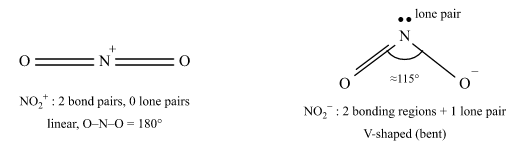
(e) (3½ marks)NO2+: N has 5 valence electrons; one is lost (positive charge), leaving 4, used in two N=O double bonds. There is no lone pair on N.
The two bonding regions repel equally and get as far apart as possible, at
180∘:
O=N+=O is linear.
NO2−: N has 5 + 1 = 6 electrons: one N=O bond, one N–O
− bond and one lone pair on N.
The three regions take a trigonal planar arrangement; the lone pair repels the bonding pairs more strongly than they repel each other, so the O–N–O angle closes to about
115∘ and the ion is V-shaped (bent).
Answer: (a) carbocation stability 3° > 2° > 1°; (b) phenoxide stabilised by delocalisation, alkoxide destabilised by +I; (c) common ion
NH4+ lowers
[OH−] below the
Ksp level; (d) water forms two hydrogen bonds per molecule, HF one; (e)
NO2+ no lone pair (linear),
NO2− one lone pair (bent)
Tip: For a shape question always count the bond pairs and the lone pairs on the central atom first.