What we are solvingW (
C3H8O) gives HCl fumes with
PCl5; X (
C3H6O) gives an orange precipitate with 2,4-dinitrophenylhydrazine
Y (
C4H6) decolourises bromine water slowly; Z (
C2H7N) gives an alkaline solution in water
We name each functional group, give two isomers of each, write the mechanism for X with 2,4-DNPH, and give tests to tell the isomers of W and of Z apart
Chapter: Organic chemistry
Topic: alcohols, carbonyl compounds, alkynes and amines; isomerism; nucleophilic addition-elimination
(a)(i) (04 marks)W: hydroxyl group,
−OH (an alcohol); only
−OH gives white fumes of HCl with
PCl5X: carbonyl group,
C=O (aldehyde or ketone); 2,4-DNPH gives orange/yellow precipitates only with carbonyl compounds
Y: carbon-carbon triple bond,
−C≡C− (an alkyne);
C4H6 is
CnH2n−2 and alkynes decolourise bromine water slowly
Z: amino group,
−NH2 /
N−H (an amine); the lone pair on N accepts a proton from water, giving
OH− ions
(a)(ii) (04 marks)W:
CH3CH2CH2OH (propan-1-ol) and
CH3CH(OH)CH3 (propan-2-ol)
X:
CH3CH2CHO (propanal) and
CH3COCH3 (propanone)
Y:
HC≡CCH2CH3 (but-1-yne) and
CH3C≡CCH3 (but-2-yne)
Z:
CH3CH2NH2 (ethylamine) and
CH3NHCH3 (dimethylamine)
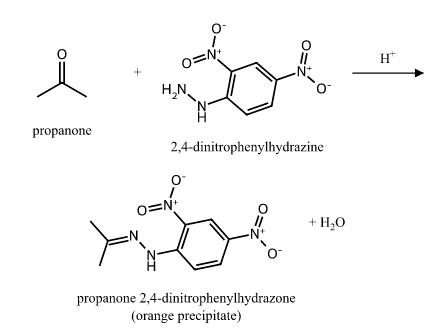
(b) (06 marks)Isomer used: propanone. Let
ArNHNH2 stand for 2,4-dinitrophenylhydrazine, Ar = 2,4-dinitrophenyl
Type: nucleophilic addition followed by elimination of water (condensation), in acid
Step 1: the C=O bond is polar,
Cδ+=Oδ−; the lone pair on the terminal
−NH2 nitrogen attacks the carbonyl carbon, and the
π electrons of C=O move onto oxygen
(CH3)2C=O+H2N-NHAr→(CH3)2C(O−)-N+H2-NHArStep 2: a proton moves from the positive nitrogen to the negative oxygen, giving a neutral addition product
(CH3)2C(O−)-N+H2NHAr→(CH3)2C(OH)-NH-NHArStep 3: the
−OH group is protonated by the acid, making a good leaving group
(CH3)2C(OH)NHNHAr+H+→(CH3)2C(O+H2)NHNHArStep 4: the lone pair on N forms C=N, water leaves and
H+ is lost from nitrogen
(CH3)2C(O+H2)NHNHAr→(CH3)2C=N-NHAr+H2O+H+Overall reaction (product: propanone 2,4-dinitrophenylhydrazone, orange precipitate):
(c) (06 marks)(i) W: reagent: iodine in sodium hydroxide solution, warm
Propan-2-ol: yellow precipitate (triiodomethane,
CHI3) with an antiseptic smell; it has the
CH3CH(OH)- group
CH3CH(OH)CH3+4I2+6OH−(aq)→CHI3(s)+CH3COO−(aq)+5I−(aq)+5H2O(l)Propan-1-ol: no yellow precipitate; the brown colour of iodine fades and the solution stays clear
(ii) Z: reagent: sodium nitrite and dilute hydrochloric acid (nitrous acid), cold
Ethylamine (primary): bubbles of a colourless gas (nitrogen) are given off
CH3CH2NH2(aq)+HNO2(aq)→CH3CH2OH(aq)+N2(g)+H2O(l)Dimethylamine (secondary): no gas; a yellow oil (an N-nitrosamine) forms
(CH3)2NH+HNO2→(CH3)2N-N=O+H2OAnswer: W alcohol (propan-1-ol, propan-2-ol); X carbonyl (propanal, propanone); Y alkyne (but-1-yne, but-2-yne); Z amine (ethylamine, dimethylamine); (b) nucleophilic addition-elimination to the 2,4-dinitrophenylhydrazone; (c)
I2/NaOH for W,
NaNO2/HCl for Z
Tip: Y decolourises bromine water
slowly: that points to the triple bond, not a diene.