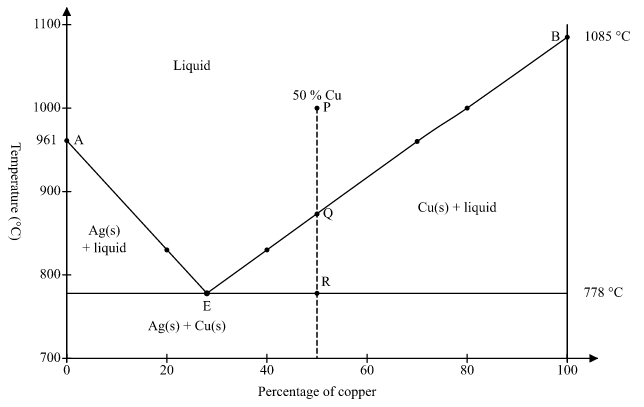
What we are solvingTable 1 gives the melting points of copper-silver mixtures: 0 % Cu 961 °C, 20 % 830 °C, 40 % 830 °C, 70 % 960 °C, 80 % 1000 °C, 100 % 1085 °C
We define a eutectic mixture, draw the phase diagram, read the eutectic point and describe the cooling of a 50 % copper melt
Then we use
Eθ values of
Ag+/Ag and
Cu2+/Cu for a cell, and discuss copper with sulphuric acid
Chapter: Phase equilibria; Electrochemistry; Transition metals
Topic: simple eutectic systems, cell e.m.f. and
ΔG, reactions of copper
(a) (01 mark)A
eutectic mixture is a mixture of two substances that melts (or solidifies) at a constant temperature, lower than that of any other mixture of the same substances, and gives a solid of the same composition as the liquid
(b)(i) (05 marks)Plot melting point (y) against percentage of copper (x) and join the points; the two lines meet at the lowest point E
Line AE: temperatures at which solid silver starts to separate; line EB: temperatures at which solid copper starts to separate
The horizontal line through E is the eutectic temperature, below which everything is solid
Regions: above AEB, liquid only; between AE and the eutectic line, solid silver + liquid; between EB and the eutectic line, solid copper + liquid; below the eutectic line, solid silver + solid copper
(b)(ii) (1½ marks)Extend line AE (through 961 °C at 0 % and 830 °C at 20 %) and line EB (through 830 °C at 40 % and 960 °C at 70 %) until they meet
Line AE:
T=961−6.55p; line EB:
T=830+4.33(p−40),
p = % copper
961−6.55p=656.7+4.33p⇒p=10.88304.3=28 %T=961−6.55(28)=778 ∘CEutectic temperature about 778 °C (read from the graph: about 780 °C)
Eutectic composition about 28 % copper and 72 % silver
(c) (4½ marks)Follow the dashed line at 50 % copper in the diagram (P to Q to R)
From 1000 °C (P) to about 873 °C (Q): the mixture is all liquid and simply cools
At about 873 °C (Q, on line EB): crystals of pure solid copper begin to separate
From Q down to 778 °C: more copper crystallises, so the remaining liquid becomes richer in silver; its composition moves down EB towards E and the rate of cooling falls
At 778 °C (R): the remaining liquid has the eutectic composition (28 % Cu); silver and copper crystallise together and the temperature stays constant until all the liquid has solidified
From 778 °C to 700 °C: the solid (copper crystals in a eutectic mixture of silver and copper) cools
(d)(i) (01 mark)Copper has the lower (less positive)
Eθ, so copper is oxidised and silver ions are reduced:
Cu(s)+2Ag+(aq)→Cu2+(aq)+2Ag(s)(d)(ii) (01 mark)Ecellθ=Eright (reduction)θ−Eleft (oxidation)θEcellθ=+0.80−(+0.34)=+0.46 V(d)(iii) (02 marks)ΔGθ=−nFEcellθn = moles of electrons transferred = 2,
F=96500 C mol−1ΔGθ=−2×96500×0.46=−88780 J mol−1=−88.78 kJ mol−1Conclusion: the reaction is feasible, because
ΔGθ is negative (equivalently
Ecellθ is positive)
(e) (04 marks)Dilute sulphuric acid: no reaction; copper is below hydrogen in the electrochemical series (
ECu2+/Cuθ=+0.34 V is positive), so it cannot displace hydrogen from the acid
In the presence of air (oxygen), dilute acid slowly dissolves copper to a blue solution:
2Cu(s)+2H2SO4(aq)+O2(g)→2CuSO4(aq)+2H2O(l)Hot concentrated sulphuric acid acts as an oxidising agent: copper dissolves and a colourless gas with a choking smell (sulphur dioxide) is given off; it turns orange acidified potassium dichromate green
Cu(s)+2H2SO4(l)→CuSO4(s)+SO2(g)+2H2O(l)A white solid (anhydrous copper(II) sulphate) forms, which gives a blue solution on dilution with water
Answer: (b)(ii) eutectic about 778 °C at 28 % Cu; (c) liquid cools to about 873 °C, copper separates, then the eutectic solidifies at 778 °C at constant temperature; (d)
Cu+2Ag+→Cu2++2Ag,
Ecellθ=+0.46 V,
ΔGθ=−88.78 kJ mol−1, feasible; (e) no reaction with dilute acid,
SO2 with hot concentrated acid
Tip: Draw the phase diagram on squared paper to scale, label every region and mark the eutectic point with its temperature and composition.