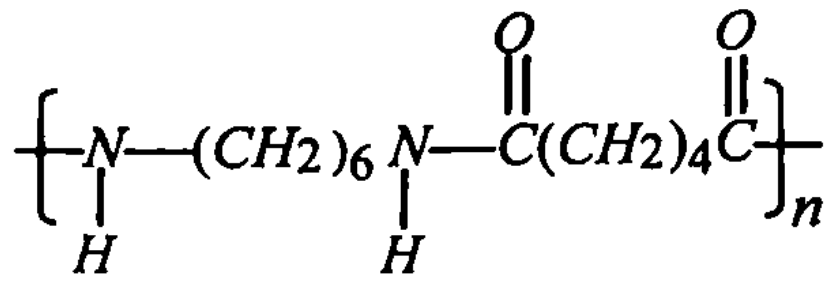
What we are solvingNylon 6,6 is a polyamide made by condensation polymerisation
We define the process, give both monomers with names, and one use
Chapter: Organic chemistry
Topic: polymers (condensation polymers)
Concept and formulasEach monomer carries two reactive groups
An amine group reacts with a carboxylic acid group to form an amide link
−CONH−A small molecule (water) is lost at every link
nH2N(CH2)6NH2+nHOOC(CH2)4COOH→[−NH(CH2)6NHCO(CH2)4CO−]n+2nH2OWorking(a) (1 mark)Condensation polymerisation is the joining of many monomer molecules (each with two functional groups) to form a polymer,
with the elimination of small molecules such as water or hydrogen chloride at each link.
(b)(i) (3 marks)Split the repeat unit at each amide link
−NH−CO−The
−NH(CH2)6NH− part comes from the diamine:
H2N−(CH2)6−NH2: hexane-1,6-diamine (hexamethylenediamine)
The
−CO(CH2)4CO− part comes from the dicarboxylic acid:
HOOC−(CH2)4−COOH: hexanedioic acid (adipic acid)
The "6,6" means 6 carbon atoms in each monomer
(b)(ii) (1 mark)Any one: making textile fibres for clothing, ropes, fishing nets, carpets, tyre cords, brush bristles
Answer: (a) monomers join with loss of small molecules (e.g. water) (b)(i)
H2N(CH2)6NH2 hexane-1,6-diamine and
HOOC(CH2)4COOH hexanedioic acid (ii) e.g. making ropes or fishing nets
Tip: To find monomers, cut every amide link and add H to N and OH to C=O