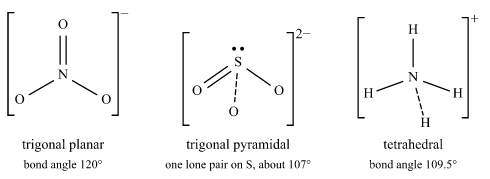
What we are solvingThree ions:
NO3−,
SO32− and
NH4+For each we draw the structure and name the shape
Chapter: Chemical bonding
Topic: shapes of molecules and ions (VSEPR theory)
Concept and formulasElectron pairs round the central atom repel and get as far apart as possible (VSEPR)
Count the bonding pairs (a double bond counts as one direction) and the lone pairs
3 bond pairs, 0 lone pairs: trigonal planar (120°)
3 bond pairs, 1 lone pair: trigonal pyramidal (about 107°)
4 bond pairs, 0 lone pairs: tetrahedral (109.5°)
WorkingTable 1 (4½ marks)NO3−: N has 5 outer electrons + 1 (charge) shared with three O atoms
One N=O and two N–O
− bonds (the double bond is delocalised), no lone pair on N
Three bonding regions:
trigonal planar, angle 120°
SO32−: S has 6 outer electrons + 2 (charge) = 8
One S=O and two S–O
− bonds use 4 of them, leaving 1 lone pair on S
Three bond pairs + one lone pair:
trigonal pyramidal, about 107°
NH4+: N forms 3 N–H bonds and a dative bond from its lone pair to
H+Four equal bond pairs, no lone pair:
tetrahedral, 109.5°
| Ion | Bond pairs / lone pairs | Name of shape |
|---|
| NO3− | 3 / 0 | trigonal planar |
| SO32− | 3 / 1 | trigonal pyramidal |
| NH4+ | 4 / 0 | tetrahedral |
Answer: NO3− trigonal planar;
SO32− trigonal pyramidal;
NH4+ tetrahedral
Tip: Always show the lone pair on S in
SO32−: it is what makes the ion pyramidal, not planar