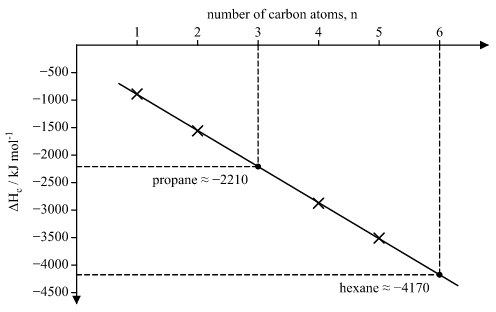
What we are solvingStandard enthalpies of combustion: methane −890, ethane −1560, butane −2877, pentane −3510 kJ mol⁻¹
Plot them against the number of carbon atoms, read off propane and hexane, explain the trend and calculate
ΔHc of hexane from heats of formation
Chapter: Energetics (thermochemistry)
Topic: enthalpy of combustion; Hess's law
Concept and formulasEach member of a homologous series has one more
CH2 than the last, so
ΔHc changes by a nearly constant amount: the graph is a straight line
Hess's law with enthalpies of formation:
ΔHr=∑ΔHf(products)−∑ΔHf(reactants)ΔHf of an element in its standard state (
O2) is zero
(a) (03 marks)Plot
ΔHc (y-axis, negative values) against n = 1, 2, 4, 5 (x-axis) and draw the best straight line
Gradient ≈ −656 kJ mol⁻¹ per extra carbon atom
(b) (01 + 01 mark)(i) Propane (n = 3): read from the line,
ΔHc≈−2210 kJmol−1(ii) Hexane (n = 6): extend the line,
ΔHc≈−4170 kJmol−1(Readings from your own graph within about ±30 kJ mol⁻¹ are acceptable)
(c) (02 marks)Each larger alkane has one more
CH2 group, so more C-C and C-H bonds are broken
But more carbon dioxide and water are formed, so more C=O and O-H bonds are made; bond formation releases more energy than bond breaking absorbs
So more heat is given out per mole (about 655 kJ more for each extra
CH2)
(d) (02 marks)For the equation as written (2 mol hexane):
ΔH=[12(−393.3)+14(−241.8)]−[2(−198.8)+19(0)]ΔH=(−4719.6−3385.2)−(−397.6)=−8104.8+397.6=−7707.2 kJPer mole of hexane:
ΔHc=2−7707.2=−3853.6 kJmol−1It is less negative than the graph value because here the water formed is a gas, not a liquid
Answer:(b) propane ≈ −2210 kJ mol⁻¹; hexane ≈ −4170 kJ mol⁻¹
(d)
ΔHc(hexane)=−3853.6 kJmol−1Tip: Divide by 2 at the end: the equation burns 2 mol of hexane, but a molar enthalpy is per 1 mol.