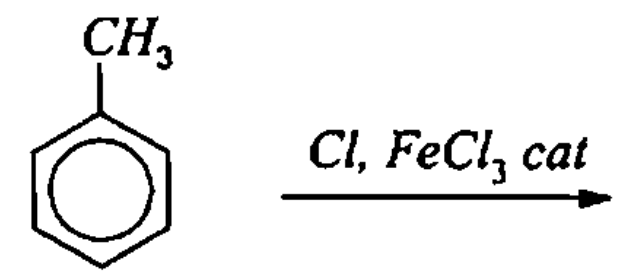
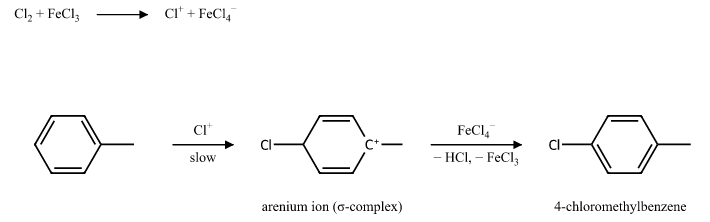
What we are solvingComplete three reactions and write their mechanisms:(a) methylbenzene with Cl2/FeCl3; (b) propene with HBr(g) at room temperature; (c) ethanol with conc. H2SO4 at 140 °CChapter: Organic chemistryTopic: electrophilic substitution, electrophilic addition, nucleophilic substitution (ether formation)Concept and formulasElectrophiles are electron-pair acceptors; they attack electron-rich benzene rings and C=C double bondsThe methyl group in methylbenzene releases electrons and directs substitution to the 2- and 4-positionsIn HBr addition the more stable (secondary) carbocation forms (Markovnikov's rule)(a) (3½ marks)C6H5CH3+Cl2FeCl3ClC6H4CH3+HClProducts: 2-chloromethylbenzene and 4-chloromethylbenzeneMechanism:Step 1, forming the electrophile: Cl2+FeCl3→Cl++FeCl4−Step 2, Cl+ attacks the ring (2- or 4-position) and forms a carbocation (arenium ion)Step 3, FeCl4− removes H+ from that carbon; the ring is restored: H++FeCl4−→HCl+FeCl3
(b) (2½ marks)CH3CH=CH2+HBr⟶CH3CHBrCH3Product: 2-bromopropaneMechanism:Step 1: the π electrons attack the Hδ+ of Hδ+−Brδ−; H adds to C-1 and the bromide ion leavesCH3CH=CH2+H−Br⟶CH3C+HCH3+Br−The secondary carbocation is more stable than the primary one (two electron-releasing alkyl groups)Step 2: the bromide ion attacks the carbocationCH3C+HCH3+Br−⟶CH3CHBrCH3(c) (03 marks)2CH3CH2OHconc. H2SO4140∘CCH3CH2OCH2CH3+H2OProduct: ethoxyethane (excess ethanol)Mechanism:Step 1: ethanol is protonated by the acidCH3CH2OH+H+⟶CH3CH2O+H2Step 2: the oxygen of a second ethanol molecule (nucleophile) attacks the CH2 carbon and water leavesCH3CH2OH+CH3CH2O+H2⟶CH3CH2O+HCH2CH3+H2OStep 3: loss of a proton gives the ether and regenerates the acid catalystCH3CH2O+HCH2CH3⟶CH3CH2OCH2CH3+H+Answer:(a) 2- and 4-chloromethylbenzene; (b) 2-bromopropane; (c) ethoxyethaneTip: At 140 °C with excess ethanol the ether forms; at 170 °C with excess acid ethene forms instead.