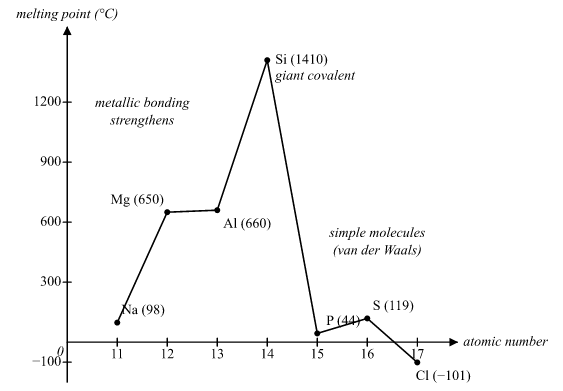
What we are solvingTable 1 gives the melting points of Na to Cl (period 3) with atomic numbers 11 to 17
Na 98, Mg 650, Al 660, Si 1410, P 44, S 119, Cl
−101 (all in
∘C)
We define melting point, plot and explain the graph, explain how Al and Cl react with dilute NaOH, and look at sulphur
Chapter: Inorganic chemistry (periodicity)
Topic: period 3 elements: structure, bonding and properties; sulphur
Concept and formulasMelting point depends on the type of structure and the strength of the forces broken on melting
Metallic bonding (Na, Mg, Al): attraction between positive ions and delocalised electrons
Giant covalent (Si): every atom held by strong covalent bonds
Simple molecular (
P4,
S8,
Cl2): weak van der Waals forces between molecules
Working(a) (1 mark)Melting point is the constant temperature at which a pure solid changes into a liquid at standard atmospheric pressure (solid and liquid are in equilibrium)
(b)(i) (4 marks)Plot melting point (y-axis) against atomic number (x-axis) and join the points
(b)(ii) (5 marks)Na to Al: melting point rises
These are metals; the number of delocalised electrons per atom increases (1, 2, 3) and the ionic radius decreases while the charge increases (
Na+,
Mg2+,
Al3+)
So the metallic bond gets stronger and more energy is needed to break it
Si: the maximum
Silicon has a giant covalent (macromolecular, diamond-like) structure; melting needs many strong Si–Si covalent bonds to be broken
P: a sharp fall
Phosphorus, sulphur and chlorine are simple molecules (
P4,
S8,
Cl2); only weak van der Waals forces are overcome on melting
S higher than P:
S8 is a bigger molecule with more electrons than
P4, so the van der Waals forces are stronger
Cl lowest:
Cl2 is the smallest molecule with the weakest van der Waals forces, so it melts below
0 ∘C(c) (6 marks)Aluminium: amphoteric; it dissolves in warm dilute sodium hydroxide with effervescence of a colourless gas (hydrogen) that burns with a pop, forming a colourless solution of sodium aluminate
2Al(s)+2NaOH(aq)+6H2O(l)→2NaAl(OH)4(aq)+3H2(g)or ionically
2Al(s)+2OH−(aq)+6H2O(l)→2[Al(OH)4]−(aq)+3H2(g)The oxide layer dissolves first:
Al2O3(s)+2OH−(aq)+3H2O(l)→2[Al(OH)4]−(aq)Chlorine: with cold dilute sodium hydroxide, the greenish-yellow chlorine is absorbed to give a pale yellow (colourless) solution of sodium chloride and sodium chlorate(I)
Cl2(g)+2NaOH(aq)→NaCl(aq)+NaOCl(aq)+H2O(l)This is disproportionation: chlorine (oxidation state 0) is reduced to
Cl− (
−1) and oxidised to
OCl− (
+1)
With hot concentrated alkali the chlorate(V) forms instead:
3Cl2+6NaOH→5NaCl+NaClO3+3H2O(d)(i) (2 marks)Rhombic (
α) sulphur and monoclinic (
β) sulphur
(d)(ii) (2 marks)Observation: the yellow sulphur dissolves and brown fumes (nitrogen dioxide) are given off; a colourless solution forms
S(s)+6HNO3(aq)→H2SO4(aq)+6NO2(g)+2H2O(l)Sulphur is oxidised from 0 to +6; nitric acid is reduced
Answer:(b) rise Na to Al (metallic), peak at Si (giant covalent), fall to P, S, Cl (simple molecular)
(c)
2Al+2OH−+6H2O→2[Al(OH)4]−+3H2;
Cl2+2OH−→Cl−+OCl−+H2OTip:Explain a melting point trend by naming the structure first, then the force broken