What we are solvingPart (a): conjugate base and conjugate acid with examples
Part (b): a mixture of
NaHCO3 and
Na2CO3;
20 cm3 needs
4.6 cm3 of
0.1 M
H2SO4 with phenolphthalein and
14.0 cm3 with methyl orange; find % of
Na2CO3 (H = 1, C = 12, O = 16, Na = 23)
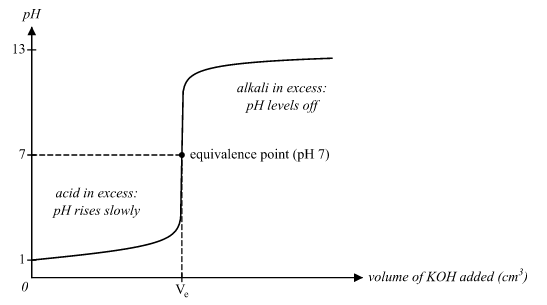
Part (c): pH curve for KOH added to HCl and its shape
Part (d): three uses of acid-base titration
Chapter: Physical chemistry (acids, bases and salts; volumetric analysis)
Topic: Brønsted-Lowry acids and bases, double-indicator titration, pH curves
Concept and formulasBrønsted-Lowry: an acid is a proton donor, a base is a proton acceptor
Phenolphthalein (range pH 8 to 10) changes colour when
Na2CO3 has only been turned into
NaHCO3Methyl orange (range pH 3 to 4.5) changes colour only when all carbonate and hydrogencarbonate have been neutralised
Moles =
1000concentration×volume (cm3), mass = moles
× MrWorking(a) (3 marks)A conjugate base of an acid is the species left when the acid loses a proton
A conjugate acid of a base is the species formed when the base gains a proton
Example:
CH3COOH(aq)+H2O(l)⇌CH3COO−(aq)+H3O+(aq)CH3COO− is the conjugate base of
CH3COOH;
H3O+ is the conjugate acid of
H2OExample:
NH3(aq)+H2O(l)⇌NH4+(aq)+OH−(aq)NH4+ is the conjugate acid of
NH3;
OH− is the conjugate base of
H2OAn acid and its conjugate base differ by one proton (a conjugate pair)
(b) (9 marks)Step 1: phenolphthalein end point, only the carbonate is half-neutralised
2Na2CO3(aq)+H2SO4(aq)→2NaHCO3(aq)+Na2SO4(aq)n(H2SO4)=10004.6×0.1=4.6×10⁻⁴ moln(Na2CO3)=2×4.6×10−4=9.2×10⁻⁴ mol in 20 cm3Step 2: methyl orange end point, everything is neutralised
Na2CO3+H2SO4→Na2SO4+CO2+H2O2NaHCO3+H2SO4→Na2SO4+2CO2+2H2On(H2SO4)total=100014.0×0.1=1.4×10⁻³ molAcid used by the carbonate (1 : 1)
=9.2×10⁻⁴ mol
n(H2SO4)for NaHCO3=1.4×10⁻³−9.2×10−4=4.8×10⁻⁴ moln(NaHCO3)=2×4.8×10−4=9.6×10⁻⁴ mol (originally present)Step 3: masses in
20 cm3Mr(Na2CO3)=2(23)+12+3(16)=106;
Mr(NaHCO3)=23+1+12+3(16)=84m(Na2CO3)=9.2×10−4×106=0.0975 gm(NaHCO3)=9.6×10−4×84=0.0806 gtotal=0.0975+0.0806=0.1782 gStep 4: percentage
% Na2CO3=0.17820.0975×100=54.7%(c)(i) (2 marks)(c)(ii) (4½ marks)At the start the pH is low (about 1): HCl is a strong acid, fully ionised, so
[H+] is high
As KOH is added,
H+(aq)+OH−(aq)→H2O(l);
[H+] falls, but the pH rises only slowly because pH is a log scale and much acid is still left
Near the equivalence point a drop of alkali removes most of the remaining
H+, so the pH rises very steeply (about pH 3 to 11) for a tiny volume
At the equivalence point pH = 7: the salt KCl comes from a strong acid and a strong base and does not hydrolyse
After equivalence,
OH− is in excess; the pH rises slowly and levels off at about 12 to 13 (the pH of the KOH solution)
(d) (1½ marks)Any three: finding the concentration of an acid or alkali; finding the percentage purity of a sample (e.g. of
Na2CO3); finding the relative molecular mass or basicity of an acid; finding the water of crystallisation of a salt; finding the nitrogen content of fertilisers (Kjeldahl method); analysing mixtures such as
NaOH/Na2CO3Answer:(b)
Na2CO3 =
54.7% of the mixture
(c) steep rise about pH 3 to 11 with equivalence at pH 7
Tip:With phenolphthalein,
Na2CO3 reacts only halfway (to
NaHCO3): double the acid moles to get the carbonate