Item 1 · Part 1What we are solvingA poison called Q is removed from the body by iodine
Sarah measured how fast the reaction starts, in three experiments
This item has one task, with several concerns
So we answer it in three parts
In this part, we find how the rate depends on Q and on iodine
Then we decide whether a large dose of iodine is needed
Chapter: Chemical kinetics
Topic: Order of reaction and the rate equation
Concept and formulasThe rate of a reaction tells us how fast a concentration changes with time
The rate depends on the concentrations of the reactants
We write this as the rate equation
Rate=k[Q]m[I2]nHere k is the rate constant
The powers m and n are the orders of reaction
An order is found only from experiments
It is never taken from the balanced equation
What does an order tell us?
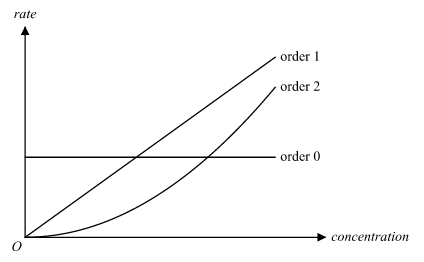
Look at the graph of rate against concentration
Order 0 means the concentration has no effect on the rate
Order one means the rate doubles when the concentration doubles
Order 2 means the rate becomes 4 times when the concentration doubles
To find one order, we compare 2 experiments
Only that one concentration should change between them
Working: order with respect to QCompare experiments 1 and 2
The iodine concentration stays at 0.1 in both
[Q]1[Q]2=0.010.02=2Rate1Rate2=1.2×10−22.4×10−2=2Divide the 2 rate equations
2m=2m=1The reaction is first order with respect to Q
Working: order with respect to iodineNo 2 experiments keep Q fixed while iodine changes
So we compare experiments 1 and 3, and use m equal to 1
Q becomes 3 times, from 0.01 to 0.03
Iodine becomes 2 times, from 0.1 to 0.2
Rate1Rate3=1.2×10−23.6×10−2=33=31×2n2n=1n=0The reaction is 0 order with respect to iodine
Working: the rate equationRate=k[Q]1[I2]0So the iodine term drops out
Rate=k[Q]The overall order is 1 + 0, which is 1
ConclusionThe rate depends only on the concentration of Q
It does not depend on the concentration of iodine
So a larger dose of iodine will not remove Q any faster
Sarah need not give the highest safe amount of iodine
She only needs enough iodine to react with all the Q
From the equation, 1 mol of iodine reacts with 2 mol of Q
Orders come from experiments, never from the balanced equation
Compare 2 experiments at a time
Answer: Rate = k[Q]; extra iodine is not needed
Item 1 · Part 2What we are solving[Q]=5.19×10⁻⁴ moldm−3[I2]=2.13×10⁻³ moldm−3Both are in moles per decimetre cubed
We find the initial rate of the reaction in the patient
Concept: the rate constantRate=k[Q]The new thing we need is the value of k
We get k by putting one experiment into the rate equation
k=[Q]RateAt a fixed temperature, k stays the same for every experiment
Working: the rate constantk=0.011.2×10−2=1.2 s−1So k is 1.2 per second
The unit, per second, suits a first order reaction
Now check with experiment 3
k=0.033.6×10−2=1.2 s−1Working: the initial rateMultiply k by the concentration of Q
Rate=1.2×5.19×10−4=6.228×10⁻⁴Rate≈6.23×10⁻⁴ moldm−3s−1The iodine concentration is not used at all
The reaction is 0 order in iodine, so that number never enters
Sarah also wants to know how fast Q leaves the body
For a first order reaction, the half life is constant
Half life is the time for the concentration to fall to half
t1/2=kln2t1/2=1.20.693≈0.58 sSo at the laboratory conditions, half of Q is removed every 0.58 s
ConclusionInitial rate=6.23×10⁻⁴ moldm−3s−1The unit is moles per decimetre cubed per second
This rate is fixed by the amount of Q
The dose of iodine does not change it
Find k from one experiment and check it with another
A 0 order reactant never enters the calculation
Answer: Initial rate = 6.23 × 10⁻⁴ mol dm⁻³ s⁻¹
Item 1 · Part 3What we are solvingSarah wants a practical procedure for the order with respect to iodine
She also wants other uses of the same principle
So we describe the experiment, step by step
Then we list where reaction rates are used in real life
Concept: follow one reactantTo study one reactant, every other condition is kept constant
So Q is used in large excess
Then its concentration hardly changes during the reaction
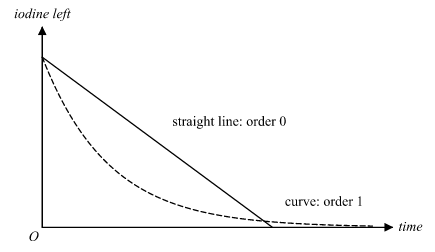
We measure the iodine left at different times
Then we plot iodine left against time
The shape of the graph gives the order
A straight line means a constant rate, so order 0
A curve with a constant half life means order one
Working: the procedurePut a known volume of Q solution, in large excess, in a flask
Keep the flask in a water bath, at a constant temperature
Add a known volume of standard iodine solution, and start a stop clock
After a fixed time, pipette a small portion into another flask
Add sodium hydroxide solution to this portion, to stop the reaction, as Sarah did
I2+2S2O32−→2I−+S4O62−Use starch indicator, and stop when the blue colour just goes
Repeat steps 3 to 5 at regular intervals of time
Plot the volume of thiosulphate against time
This volume is proportional to the iodine left
A straight line shows that the order with respect to iodine is 0
There is a second method, the initial rates method
Carry out several runs with the same concentration of Q
Change only the concentration of iodine in each run
Measure the initial rate of every run
If the rate does not change, the order with respect to iodine is 0
Working: other applicationsA drug's half life fixes the dose and its timing
The rate of decay fixes the expiry date
A refrigerator slows the rate of spoilage
Conditions and a catalyst are chosen for a fast reaction
The decay of carbon 14 gives the age of remains
ConclusionSarah should keep Q in excess and follow the iodine by titration
A straight line graph of iodine left against time confirms order 0
The same study of rates guides drug doses, expiry dates, food storage and industry
To study one reactant, keep all the others in large excess
The shape of the graph gives the order
Answer: Sample, stop, titrate, plot the graph