Item 2 · Part 1What we are solvingA factory will make ammonia from nitrogen and hydrogen
It can run at 700 degrees Celsius or at 500 degrees Celsius
Kc (700∘C)=1.02×10⁻⁵At 500 degrees, K c is not known
This item has one task, so we answer it in three parts
In this part, we find K c at 500 degrees
Then we choose the better temperature
Chapter: Chemical equilibrium
Topic: The equilibrium constant, Kc
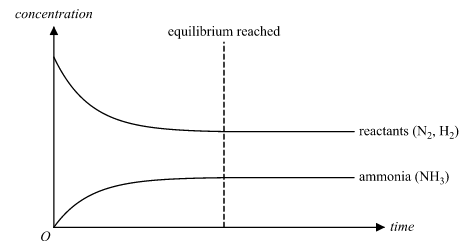
Concept and formulasN2+3H2⇌2NH3At first the reactants fall and the ammonia rises
At equilibrium, the forward and backward rates are equal
So all the concentrations stay constant
Kc compares products with reactants at equilibrium
Products go on top, reactants go below
Each concentration carries its number of moles from the equation as an index
Kc=[N2][H2]3[NH3]2A large Kc means a lot of product at equilibrium
For one reaction, Kc changes only with temperature
Working: the equilibrium concentrationsThe equation gives the mole ratio
1 mol of nitrogen and 3 mol of hydrogen give 2 mol of ammonia
The ammonia formed is 170
N2 used=2170=85H2 used=3×85=255[N2]=100−85=15 moldm−3[H2]=300−255=45 moldm−3All are in moles per decimetre cubed
Working: the value of KcKc=15×45317021702=28900453=91125Kc=15×9112528900=0.0211That gives 0.0211
On top we have concentration squared
Below we have concentration to the power 4
Kc=0.0211 mol−2dm6The paper prints decimetres cubed with the value at 700 degrees
That is a misprint, the power is 6
Working: comparing the two temperaturesAt 500 degrees, Kc is 0.0211
At 700 degrees, it is only 1.02 ×
10−51.02×10−50.0211≈2000Kc at 500 degrees is about 2000 times larger
A larger Kc means more ammonia at equilibrium
Also, Kc falls when the temperature rises
This shows that the forward reaction is exothermic
ConclusionThe best temperature is 500 °C
It gives a much higher yield of ammonia than 700 degrees
It also needs less heating, so the fuel cost is lower
The catalyst keeps the reaction fast at this lower temperature
Always find the equilibrium concentrations first, from the mole ratio
Only then put them into Kc
Answer: Kc = 0.0211 at 500 °C: use 500 °C
Item 2 · Part 2What we are solvingAn alkaline buffer is made from aqueous ammonia and ammonium chloride
pH=8.03We find the ratio of ammonia to ammonium chloride that gives this P H
Kb=1.8×10⁻⁵ moldm−3pKw=14.0Concept: buffer solutionsA buffer keeps its pH almost constant when a little acid or alkali is added
An alkaline buffer is a weak base mixed with its salt
Here ammonia is the weak base
NH3+H2O⇌NH4++OH−Ammonium chloride is the salt
NH4Cl→NH4++Cl−How does it resist change?
NH3+H+→NH4+NH4++OH−→NH3+H2OSo the hydroxide concentration hardly moves
Kb=[NH3][NH4+][OH−]Rearrange it for the ratio we want
[NH4+][NH3]=Kb[OH−]The ammonium comes from the salt
So this is the ratio of ammonia to ammonium chloride
pH+pOH=pKwWorking: the hydroxide concentrationpOH=14.0−8.03=5.97[OH−]=10−5.97[OH−]=1.07×10⁻⁶ moldm−3The unit is moles per decimetre cubed
Working: the ratioDivide the hydroxide concentration by Kb
[NH4Cl][NH3]=1.8×10−51.07×10−6[NH4Cl][NH3]=0.0595So ammonia to ammonium chloride is 0.0595 to 1
0.05951=16.8[NH3]:[NH4Cl]=1:16.8Let us check by a second method
pOH=pKb+log[base][salt]pKb=−log(1.8×10⁻⁵)=4.745log[base][salt]=5.97−4.745=1.225[base][salt]=101.225=16.8The salt is 16.8 times the base, as before
Conclusion[NH3]:[NH4Cl]=1:16.8So the buffer needs about 17 times more ammonium chloride than ammonia
With this mixture, the pH stays at 8.03
For an alkaline buffer, work with pOH, not pH
Subtract the pH from pKw first
Answer: NH₃ : NH₄Cl = 1 : 16.8
Item 2 · Part 3What we are solvingThe investor wants the factors that affect the production of ammonia
He also wants other uses of this chemical system in real life
The chemical system here is a reversible reaction at equilibrium, and a buffer
Concept: Le Chatelier's principleLe Chatelier's principle guides us
N2(g)+3H2(g)⇌2NH3(g)Forward reaction: exothermic
4 moles of gas → 2 moles of gas
Working: the factorsA low temperature favours the exothermic side, so the yield of ammonia rises
But a very low temperature makes the reaction too slow
So industry uses a moderate temperature, about 450 to 500 °C
A high pressure favours the side with fewer moles of gas
That is the ammonia side
So the yield rises at high pressure, about 200 atmospheres
A still higher pressure needs very strong and costly vessels
Adding more nitrogen and hydrogen shifts the equilibrium to the right
Removing ammonia also shifts it to the right
So ammonia is cooled to a liquid and taken out
The unused gases are sent back into the reactor
4. Catalyst: finely divided iron
A catalyst speeds up the forward and the backward reaction equally
So equilibrium is reached in a shorter time
It does not change the yield, and it does not change Kc
Working: other applications2SO2+O2⇌2SO3Carbon dioxide is kept dissolved by high pressure in the bottle
A hydrogencarbonate buffer holds the pH of blood near 7.4
4, buffers keep the pH steady in medicines, foods and shampoos
5, the ammonia itself makes fertilisers and nitric acid
ConclusionThe production of ammonia depends on temperature, pressure, concentration and the catalyst
The investor should use moderate temperature, high pressure and an iron catalyst
Ammonia should be removed as it forms
The same ideas of equilibrium and buffers serve industry, food and medicine
A catalyst changes how fast equilibrium is reached
It never changes the position of equilibrium
Answer: Temperature, pressure, catalyst