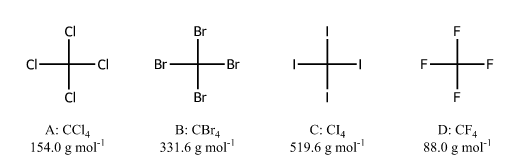
Item 3 · Part 1What we are solvingA liquid waste contains four substances, A, B, C and D
Each has one carbon atom, and the rest are atoms of one halogen
We know only their molar masses
This item has one task, so we answer it in three parts
In this part, we find the formula and the name of each substance
Chapter: Group 17, the halogens
Topic: Molar mass and molecular formula
Concept and formulasCarbon is in Group 14, so it has 4 outer electrons
It forms 4 covalent bonds
A halogen atom forms 1 bond
So one carbon atom joins with 4 halogen atoms
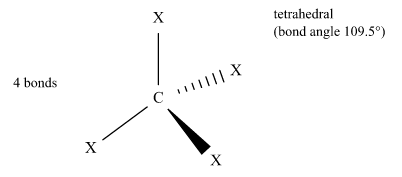
CX4The molecule is tetrahedral
The molar mass is the sum of the atomic masses
M=12+4AXAX=4M−12Then we look for that atomic mass in the periodic table
The periodic table is attached to the question paper
Working: substance AIts molar mass is 154
154 − 12 is 142
AX=4154.0−12=4142=35.5That is the atomic mass of chlorine
A=CCl4 (tetrachloromethane)Working: substance BIts molar mass is 331.6
331.6 − 12 is 319.6
AX=4331.6−12=4319.6=79.9That is the atomic mass of bromine
B=CBr4 (tetrabromomethane)Working: substance CIts molar mass is 519.6
519.6 − 12 is 507.6
AX=4519.6−12=4507.6=126.9That is the atomic mass of iodine
C=CI4 (tetraiodomethane)Working: substance DIts molar mass is 88
88 − 12 is 76
AX=488.0−12=476=19That is the atomic mass of fluorine
D=CF4 (tetrafluoromethane)ConclusionC is tetraiodomethane
So the waste holds
The 4 tetrahalides of carbon
The halogens present are fluorine, chlorine, bromine and iodine
Subtract the known atoms from the molar mass first
Then divide by the number of unknown atoms
Answer: CCl₄, CBr₄, CI₄ and CF₄
Item 3 · Part 2What we are solvingThe waste contains fluorine, chlorine, bromine and iodine, joined to carbon
The company wants to know how these halogens react
We write their reactions with metals, with alkalis and with water
Concept: halogens are oxidising agentsA halogen atom has 7 outer electrons
It needs one more electron to fill its shell
X2+2e−→2X−That makes it an oxidising agent
Fluorine is the strongest, because its atom is the smallest
F2>Cl2>Br2>I2Working: reaction with metalsA heated metal burns in a halogen and forms a salt, called a halide
2Na+Cl2→2NaCl2Fe+3Cl2→2FeCl32Fe+3Br2→2FeBr3Iodine is a weaker oxidising agent
Fe+I2→FeI2Working: reaction with alkalisCl2+2NaOH→NaCl+NaOCl+H2O3Cl2+6NaOH→5NaCl+NaClO3+3H2OIn both, chlorine is oxidised and reduced at the same time
Bromine and iodine react in the same way
Fluorine behaves differently, because it is so strongly oxidising
2F2+2NaOH→2NaF+OF2+H2O2F2+4NaOH→4NaF+O2+2H2OWorking: reaction with water2F2+2H2O→4HF+O2Chlorine dissolves and reacts partly
Cl2+H2O⇌HCl+HOClChloric 1 acid bleaches and kills germs
Br2+H2O⇌HBr+HOBrIodine hardly dissolves, and hardly reacts with water
ConclusionWith metals, the halogens form halide salts
With alkalis, they form a halide and a halate
With water, they form acids, and fluorine sets oxygen free
In every case the reactivity falls from fluorine to iodine
Their reactivity falls down the group
So always compare along the group
Answer: Halides, halates and acids are formed
Item 3 · Part 3What we are solvingThe company wants to recycle the four compounds, not destroy them
So it needs a method to separate them
It must also tell manufacturers about the dangers to health and to the environment
Concept: nature of the substancesAll 4 are simple covalent molecules
Each molecule is symmetrical, so it is non polar
Between the molecules there are only weak van der Waals forces
These forces grow stronger as the molar mass increases
Boiling point rises with molar mass
CF4<CCl4<CBr4<CI4Working: the separation techniqueThe compounds mix with each other, but their boiling points differ
So the suitable technique is fractional distillation
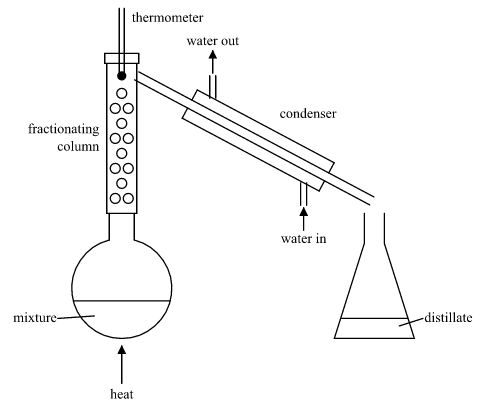
The mixture is heated gently in a flask
The compound with the lowest boiling point turns to vapour first
Its vapour rises up the fractionating column
Then the condenser cools it back to a liquid
It is collected as the first fraction
The thermometer shows which fraction is coming over
When the temperature rises, the receiver is changed
Each compound is collected at its own boiling point
The compounds do not dissolve in water, because they are non polar
So any water in the waste forms a separate layer
It is first removed with a separating funnel
Working: health impactsThe vapours are poisonous when breathed in
Tetrachloromethane damages the liver and the kidneys
Long exposure can cause cancer
The liquids also pass through the skin and irritate it
Workers therefore need masks, gloves and good ventilation
Working: environmental impactsIn the upper air, the chlorine and bromine compounds release free radicals
These destroy the ozone layer, so more ultraviolet light reaches the earth
Tetrafluoromethane is a strong greenhouse gas, so it adds to global warming
The compounds do not break down easily
They pollute water and soil for many years
Keep the compounds in closed containers and closed systems
Recover and recycle them by distillation
Never pour them into drains, and never burn them in the open
Where possible, use safer solvents in their place
ConclusionThe compounds are separated by fractional distillation, because their boiling points differ
They harm the liver, the ozone layer and the climate
So they must be handled in closed systems and recycled
Link every property to the structure
Weak forces between molecules mean low boiling points, so distillation works
Answer: Fractional distillation; handle safely