Item 4 · Part 1What we are solvingAn ore contains two unknown elements, E and G
Some of their data is missing
We have full data for sodium and for iron
This item has one task, so we answer it in three parts
In this part, we read what each property tells us
Then we predict the missing values for E and G
Chapter: Periodicity
Topic: Trends in the properties of metals
Concept and formulasEach property in the table tells a story
A large atomic radius means the outer electrons are held weakly
Ionisation energy is the energy needed to remove an electron
A sudden jump in ionisation energy means a new inner shell is being broken
Melting point and density show how strong and how close the metallic bonding is
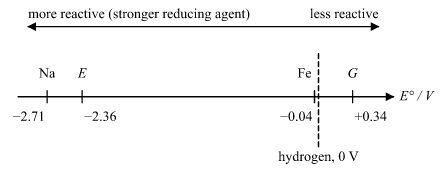
The standard electrode potential shows how easily a metal forms ions
Look at the number line
A large negative value means the metal loses electrons easily
Such a metal is a strong reducing agent, and is reactive
Hydrogen is the reference, at 0 V
A positive value means the metal is less reactive than hydrogen
Working: sodium and ironFirst the 2 known metals
Sodium: 496, then 4562 (huge jump)
This huge jump shows only one outer electron
So sodium is an s block metal of Group 1
1 electron per atom gives weak metallic bonding
So sodium has a low melting point and a low density
Iron: 759, then 1561 (no jump)
There is no big jump
Iron uses its 4 s and 3 d electrons in bonding
So its metallic bonding is strong
It has a small radius, a high melting point and a high density
Iron is a d block transition metal
Working: element EIts electrode potential is −2.36, close to sodium
So E is a reactive s block metal
E: second ionisation energy 1451, sodium 4562
So the second electron also comes from the outer shell
E has 2 outer electrons, and is in Group 2
E: radius 0.160, sodium 0.186
Now the missing values of E
2 electrons per atom and a smaller ion give stronger bonding than in sodium
Melting point of E: between 370 K and 1808 K
First ionisation energy of E: between 496 and 1451
But it is below its own second value, 1451
Density of E: between 0.97 and 7.87
Working: element GG: radius 0.128, iron 0.124
G: first ionisation energy 745, iron 759
So G is a d block transition metal, like iron
Its electrode potential is +0.34
So G is less reactive than hydrogen, and less reactive than iron
Now the missing values of G
Like iron, G has strong metallic bonding
Melting point of G: high, near 1808 K
Its second ionisation energy has no big jump
Second ionisation energy of G: near 1561
Density of G: high, near 7.87
ConclusionE is a reactive s block metal with 2 outer electrons
Its missing values lie between those of sodium and iron
G is an unreactive d block transition metal
Its missing values are close to those of iron
The data of E fit magnesium, and the data of G fit copper
Look for the big jump in ionisation energy
The number of electrons before the jump gives the group
Answer: E is like magnesium, G is like copper
Item 4 · Part 2What we are solvingWe place E and G in the periodic table
Sodium and iron are our guides
Then we predict how each one reacts
The reagents are water, oxygen and dilute acids
Concept: position and electrode potentialFrom part one, E has 2 outer electrons, and G is a transition metal
Across a period, the atomic radius decreases
A metal reacts by losing electrons
So a metal with a negative electrode potential displaces hydrogen from water and acids
When the electrode potential is positive, the metal cannot do this
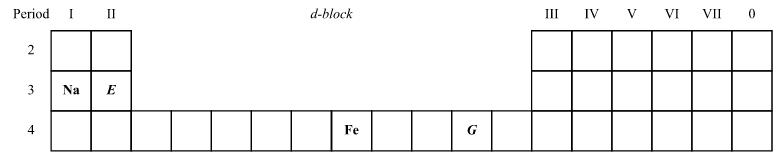
Working: the positionsSodium is in Group 1, Period 3
E is smaller than sodium, and has 2 outer electrons
E: Group 2, Period 3 (s-block)
Iron is in the d block, in Period 4
G is close to iron in radius and ionisation energy
But it is much less reactive
G: Period 4, d-block, right of iron
Working: reactions of EIts electrode potential is −2.36, so it is a strong reducing agent
E+2H2O(l)→E(OH)2+H2E+H2O(g)→EO+H22E+O2→2EOE+2HCl→ECl2+H2Working: reactions of GIts electrode potential is +0.34, so it is a weak reducing agent
Water and even steam have no action on G
2G+O2→2GOG+HCl(aq)→no reaction3G+8HNO3→3G(NO3)2+2NO+4H2OConclusionE is in Group 2 and Period 3, next to sodium
It reacts with steam, burns in oxygen and dissolves in dilute acids
G is a Period 4 transition metal, to the right of iron
It does not react with water or dilute acids, and only slowly with oxygen
A negative electrode potential means the metal displaces hydrogen
A positive value means it cannot
Answer: E is reactive, G is unreactive
Item 4 · Part 3What we are solvingThe company will mine and process an ore of E and G
We give the dangers to health
We give the damage to the environment
And we say how to reduce each of them
Concept: where the dangers come fromThe dangers follow from the chemistry of the 2 metals
E is very reactive, so its powder burns easily
G is a heavy transition metal, and its ions are poisonous
Mining and crushing also produce dust, waste rock and dirty water
Working: health issuesOne, dust from drilling and crushing is breathed in
2, ions of G in food or water are poisonous
They harm the liver and the kidneys
3, powdered E catches fire easily
It burns with great heat and a blinding flame
4, noise and heavy machines cause deafness and accidents
Working: environmental issuesOne, open pits destroy land, forests and farms
The bare soil is then eroded
2, waste water carries ions of G into rivers
They kill fish and water plants
3, heaps of waste rock spoil the land
Rain washes metal ions out of them
4, many ores are sulphides
SO2+H2O→H2SO3Working: mitigation measuresOne, spray water to settle dust, and give workers masks and ear protection
2, treat waste water with lime before it leaves the plant
G2++2OH−→G(OH)2(s)3, store waste in lined dams, away from rivers
4, absorb the sulphur dioxide, and turn it into sulphuric acid
5, refill the pits and plant trees
6, keep powdered E dry, and away from flames
ConclusionThe ore brings dust, poisonous metal ions, fire risk and damaged land
The company should control dust and treat its waste water with lime
It should also absorb waste gases and restore the mined land
For every danger you name, give one matching measure
Marks are given for the pair
Answer: Dust and metal waste; treat and protect