Question Numbers: 5-6Item 5Structures of organic compounds play a great role in their functionality as solvents, varnishes and paints.A carpentry workshop uses four organic compounds W, X, Y and Z to add value to their products but the customers have raised concerns about bad odour, toxicity and fading of the products. The information about the four compounds is shown in table 5.Table 5: Properties and uses of the four organic compounds
Organic compound
Structural characteristics
Boiling point (∘C)
Use
W
2- Carbon alcohol
78
Solvent
X
6- Carbon aromatic nitro compound
210
Varnish
Y
3- Carbon secondary amine
35
Paint binder (Blending paint)
Z
Synthetic Vinyl chloride (chloroethene polymer)
195
Sticks the varnish
In trying to address the customers concerns, the carpentry workshop owner consulted a chemist who advised that:I. Phenylamine produced from ethene can be used instead of Y to improve odour.II. W can be dehydrated to produce more ethene and can also be converted into a fruity sweet-smelling solvent.III. The toxicity of X can be mitigated by converting it to the less toxic phenol for the same purpose, but several other environmental safety concerns remain unaddressed.The carpentry workshop owner did not understand the chemist’s advice. He further requested for information about the mechanisms for the reactions undertaken by W and X as recommended by the chemist, an assessment of the environmental impact and mitigation measures to be taken while using compound Z.
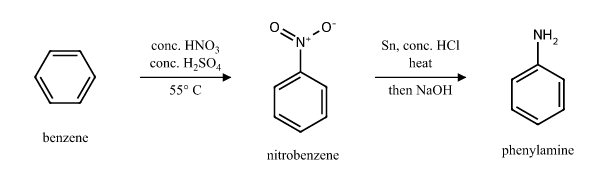
Item 5 (b) · Part 1What we are solvingThe chemist gave three pieces of adviceTask B asks us to analyse them, so we take one advice in each partAdvice one says phenylamine, made from ethene, can replace Y to improve the odourWe show how ethene becomes phenylamineThen we judge whether the odour improvesConcept: a synthesis routeA large molecule is built from a small one in stepsEach step changes one functional group, with its own reagent and conditionEthene has 2 carbon atoms, but phenylamine has a ring of 6So we first build the benzene ring3C2H2→C6H6Working: ethene to benzeneIt forms 1, 2 dibromoethaneCH2=CH2+Br2→CH2BrCH2BrHeat this with excess potassium hydroxide dissolved in ethanolCH2BrCH2Br+2KOH→HC≡CH+2KBr+2H2O3HC≡CH→C6H6It forms benzeneWorking: benzene to phenylamineWarm benzene with concentrated nitric acid and concentrated sulphuric acid, at 55 °C
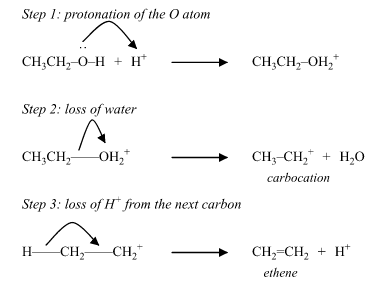
C6H6+HNO3→C6H5NO2+H2OHeat nitrobenzene with tin and concentrated hydrochloric acidC6H5NO2+6[H]→C6H5NH2+2H2OWorking: judging the advicePhenylamine has a much larger molecule than YIts boiling point is far higher, so little vapour escapesSo the smell is much less, and the odour does improveNotice that step 4 gives nitrobenzene, which is XThe workshop already has XSo in practice, only step 5 is neededPhenylamine is toxic, and it passes through the skinIn air it slowly turns brown, so it may darken a paintSo the workers must use gloves and good ventilationConclusionThe first advice is soundEthene gives phenylamine in 5 steps, through ethyne, benzene and nitrobenzenePhenylamine smells far less than Y, so the odour improvesBut it is toxic, so it must be handled with careIn a synthesis, count the carbon atoms firstThen write one step at a time, with reagent and conditionAnswer: Ethene to phenylamine in 5 stepsItem 5 (b) · Part 2What we are solvingAdvice two is about W, which is ethanolIt can be dehydrated to give more etheneIt can also be changed into a fruity sweet-smelling solventWe give both reactions, and the mechanism of eachConcept: elimination and esterificationDehydration means removing water from one moleculeIt is an elimination reaction, and it leaves a double bondA fruity sweet smell is the sign of an esterAn ester forms when an alcohol reacts with a carboxylic acidBoth reactions use concentrated sulphuric acid, which supplies hydrogen ionsWorking: dehydration of ethanolHeat ethanol with excess concentrated sulphuric acid, at about 180 °CCH3CH2OHconc.H2SO4,180∘CCH2=CH2+H2ONow its mechanism, in 3 stepsA lone pair on the oxygen takes a hydrogen ion from the acid
Step 2 is loss of waterThe carbon to oxygen bond breaks, and a carbocation remainsStep 3 is loss of a hydrogen ionThe next carbon gives it up, and the bond pair forms the double bondSo ethene is formed, and the acid gets its hydrogen ion backWorking: the fruity solventCH3CH2OH+2[O]→CH3COOH+H2OThis is done by heating with acidified potassium dichromateThen ethanol and ethanoic acid are warmed with a little concentrated sulphuric acidCH3COOH+CH3CH2OH⇌CH3COOCH2CH3+H2OEthyl ethanoate has a fruity sweet smell, and it is a good solventNow the mechanism of esterificationCH3COOH+H+⇌CH3C+(OH)2This makes the carbonyl carbon more positiveCH3C+(OH)2+CH3CH2OH⇌CH3C(OH)2−O+(H)CH2CH3⇌CH3C+(OH)OCH2CH3+H2O⇌CH3COOCH2CH3+H+ConclusionThe second advice is also soundEthanol loses water with hot concentrated sulphuric acid, and gives etheneEthanol also reacts with ethanoic acid, and gives ethyl ethanoateThat ester is the fruity sweet smelling solventBoth reactions start with a hydrogen ion joining an oxygen atomIn a mechanism, show every charge and every curved arrowAn arrow starts at an electron pairAnswer: W gives ethene and ethyl ethanoateItem 5 (b) · Part 3What we are solvingAdvice three is about X, which is nitrobenzeneThe chemist wants it changed into the less toxic phenolWe show the route and the mechanismThen we assess compound Z, which is P V CConcept: the diazonium saltA nitro group cannot be changed to a hydroxyl group directlyWe go through the amineA primary aromatic amine reacts with cold nitrous acidIt forms a diazonium saltThe diazonium group leaves easily as nitrogen gasSo water can take its place, and phenol is formedWorking: nitrobenzene to phenolIn the first step, heat nitrobenzene with tin and concentrated hydrochloric acid
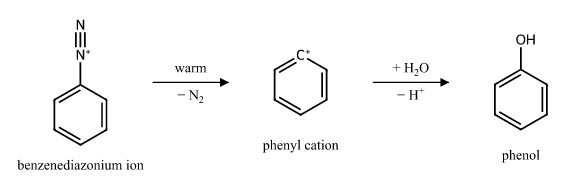
In the second step, add sodium nitrite and dilute hydrochloric acid, below 10 °CIn the third step, warm the solutionThe salt reacts with water, and gives phenol and nitrogenHere are the equations of the 3 stepsC6H5NO2+6[H]→C6H5NH2+2H2OC6H5NH2+NaNO2+2HCl→C6H5N2+Cl−+NaCl+2H2OC6H5N2+Cl−+H2O→C6H5OH+N2+HClWorking: the mechanismFirst, the carbon to nitrogen bond breaks
Nitrogen gas leaves, and a phenyl cation remainsNext, a lone pair on the oxygen of water attacks the positive carbonFinally, a hydrogen ion is lost, and phenol is formedThe reduction of the nitro group has no simple mechanism at this levelWorking: the remaining concernsPhenol is less toxic than nitrobenzene, but it is still harmfulIt burns the skin, and it poisons fish if it reaches waterThe route also leaves tin salts and acid as wasteSo the waste must be neutralised and treated before disposalWorking: compound Z and the environmentSo waste PVC stays in soil and drains for many yearsWhen burnt, it gives hydrogen chloride and other poisonous fumesHydrogen chloride causes acid rain and harms the lungsWhat should the workshop do?Use only the amount of Z that is neededCollect the waste, and send it for recyclingNever burn it in the openHCl+NaOH→NaCl+H2OConclusionThe third advice works in 3 steps, through phenylamine and a diazonium saltPhenol is less toxic, but it must still be handled with carePVC does not decay, and gives acid fumes when burntSo the workshop should recycle it, and never burn it in the openA nitro group reaches a hydroxyl group only through the amine and the diazonium saltKeep the diazonium step coldAnswer: X to phenol in 3 steps; recycle Z