Item 6 · Part 1What we are solvingA company needs a ketone R, which has three carbon atoms
R is not on the market
It must be made from the cheap product of fermentation
This item has one task, so we answer it in five parts
In this part, we identify R
Then we show how to make it from the fermentation product
Chapter: Organic chemistry
Topic: Carbonyl compounds
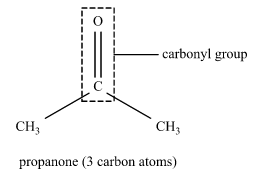
Concept and formulasA ketone has a carbonyl group, with a carbon group on each side
So the smallest ketone needs 3 carbon atoms
R=CH3COCH3 (propanone)Fermentation of carbohydrates gives ethanol
C6H12O6→2CH3CH2OH+2CO2Ethanol has 2 carbon atoms, but propanone has 3
So we must join carbon atoms
We do that by heating a calcium salt of a carboxylic acid
2 ethanoate groups join, and one carbon is lost as carbonate
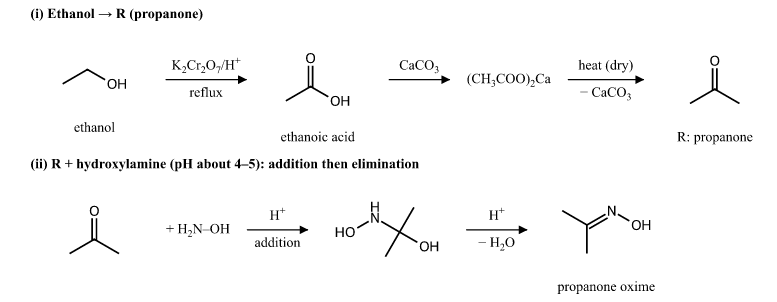
Working: ethanol to propanoneHeat ethanol under reflux with acidified potassium dichromate
CH3CH2OH+2[O]→CH3COOH+H2O2CH3COOH+Ca(OH)2→(CH3COO)2Ca+2H2OEvaporate the solution to get dry calcium ethanoate
Heat the dry calcium ethanoate strongly
(CH3COO)2Ca→CH3COCH3+CaCO3ConclusionR is propanone, the ketone with 3 carbon atoms
The company can make it from ethanol in 3 steps
Ethanol is oxidised to ethanoic acid
The acid is changed to calcium ethanoate, which is heated to give propanone
Count the carbon atoms of the starting material and of the product
If the product has more, a carbon to carbon bond must be made
Answer: R is propanone, made from ethanol
Item 6 · Part 2What we are solvingR, which is propanone, reacts with hydroxylamine in acid
A stable product is formed
We name the product, write the equation, and give the mechanism
Concept: addition then eliminationIn the carbonyl group, oxygen pulls the electrons towards itself
Cδ+=Oδ−Hydroxylamine has a lone pair on its nitrogen, so it is a nucleophile
It adds to the carbonyl carbon
Then a molecule of water is eliminated, and a carbon to nitrogen double bond forms
This is called a condensation, or addition and elimination, reaction
Working: the reaction(CH3)2C=O+H2N−OH→(CH3)2C=N−OH+H2OThe oxime is a stable crystalline solid
Its sharp melting point is used to identify the ketone
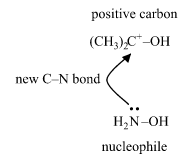
Working: the mechanism(CH3)2C=O+H+⇌(CH3)2C+−OHThe carbonyl carbon becomes fully positive
The lone pair on the nitrogen of hydroxylamine attacks this carbon
A new carbon to nitrogen bond forms
(CH3)2C(OH)−N+H2OH⇌(CH3)2C(O+H2)−NHOH→(CH3)2C=N+H−OH+H2O→(CH3)2C=N−OH+H+The oxime is formed, and the acid catalyst is returned
One caution about the acid
Only a little acid is used
Too much acid would join to the nitrogen of hydroxylamine
Its lone pair would be used up, and it could no longer attack
ConclusionPropanone reacts with hydroxylamine to form propanone oxime and water
The mechanism is nucleophilic addition, followed by elimination of water
The acid is a catalyst, and it is recovered at the end
A carbonyl carbon is always attacked by a nucleophile
Start the curved arrow at the lone pair
Answer: Propanone oxime is formed
Item 6 · Part 3What we are solvingThree amines are available to the company
When they are scarce, amines must be made from amides
The method chosen is the Hofmann degradation
We give the reaction, its mechanism, and what it can make
First, a caution about the printed names
The formula beside ethylamine has 2 methyl groups on nitrogen
(CH3)2NH secondaryThe formula beside dimethylamine has 3 methyl groups
(CH3)3N tertiaryCH3NH2 primaryConcept: the Hofmann degradationAn amide is warmed with bromine and concentrated sodium hydroxide solution
RCONH2+Br2+4NaOH→RNH2+Na2CO3+2NaBr+2H2OThe carbonyl carbon is removed as carbonate
That is why it is called a degradation
The carbon chain becomes shorter by 1
Working: making methylamineTo make methylamine, we start with ethanamide
Ethanamide has 2 carbon atoms, and methylamine has 1
Warm ethanamide with bromine and concentrated sodium hydroxide
CH3CONH2+Br2+4NaOH→CH3NH2+Na2CO3+2NaBr+2H2OWorking: the mechanismCH3CONH2+Br2+OH−→CH3CONHBr+Br−+H2OThis gives an N bromo amide
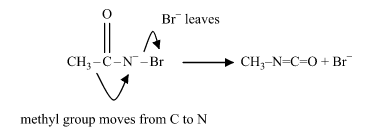
CH3CONHBr+OH−→CH3CON−Br+H2OThe nitrogen now carries a negative charge
Step 3 is the key step, a rearrangement
The methyl group moves from the carbon to the nitrogen
At the same time, the bromide ion leaves
The product is methyl isocyanate
Hydroxide and water break up the isocyanate
CH3NCO+2OH−→CH3NH2+CO32−Working: what the method can makeIt gives only primary amines
So it gives methylamine, but not the other 2 directly
They are made from methylamine and a halogenoalkane
CH3NH2+CH3I→(CH3)2NH+HI(CH3)2NH+CH3I→(CH3)3N+HIConclusionDuring scarcity, ethanamide with bromine and sodium hydroxide gives methylamine
The key step is a rearrangement, in which the carbon chain loses one carbon
The secondary and tertiary amines are then built from methylamine
In the Hofmann degradation, the amine has one carbon less than the amide
Choose the amide with one carbon more
Answer: Amide + Br₂ + NaOH gives a primary amine
Item 6 · Part 4What we are solvingWorkers must know the basic strength of the three amines
We explain what makes an amine a base
Then we arrange the three amines in order of basic strength
Concept: why amines are basesThe nitrogen atom of an amine has a lone pair of electrons
This lone pair accepts a hydrogen ion
So an amine is a base
RNH2+H2O⇌RNH3++OH−The more available the lone pair, the stronger the base
2 things decide the strength
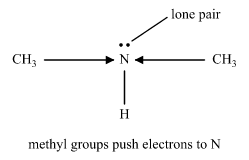
The first is the inductive effect
A methyl group pushes electrons towards the nitrogen
So the lone pair becomes more available
More methyl groups push more
The ion that forms is held by water through its NH bonds
Many methyl groups crowd the nitrogen and leave few NH bonds
Working: comparing the aminesMethylamine: one methyl group
So it is a stronger base than ammonia
Dimethylamine: two methyl groups, strongest
The push is greater, and its ion still has 2 NH bonds for water
So dimethylamine is the strongest of the 3
Trimethylamine: three methyl groups, crowded
But its ion has only one NH bond, and the nitrogen is crowded
Water cannot stabilise this ion well
So in water, trimethylamine is the weakest of the 3
It is still a stronger base than ammonia
Working: the order(CH3)2NH>CH3NH2>(CH3)3N>NH3In the names printed on the paper, ethylamine is first, then methylamine, then dimethylamine
The strongest base is also the best nucleophile
So it reacts first in a synthesis
ConclusionThe secondary amine is the strongest base
The primary amine comes next, and the tertiary amine is the weakest
The inductive effect raises the strength, and crowding lowers it
Workers can use this order to predict which amine reacts first
Basic strength depends on 2 effects together
Never judge it by the number of methyl groups alone
Answer: (CH₃)₂NH > CH₃NH₂ > (CH₃)₃N
Item 6 · Part 5What we are solvingThe regulator wants unused propanone changed into propanal
The company also wants the health and environmental issues of the amines and of R
The mechanism asked for scarcity was given in part three
So here we give the route to propanal
Then we give the dangers and the safety measures
Concept: moving the functional groupPropanone and propanal both have 3 carbon atoms
In propanone, the oxygen is on the middle carbon
In propanal, it is on the end carbon
CH3COCH3⟶CH3CH2CHOWe do it through an alkene
Hydrogen bromide with a peroxide adds bromine to the end carbon
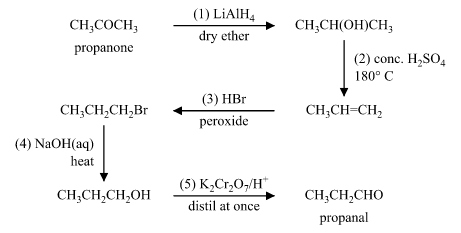
Working: propanone to propanalFirst, reduce propanone with lithium aluminium hydride in dry ether
This gives propan 2 ol
Second, heat it with concentrated sulphuric acid at 180 °C
Third, add hydrogen bromide in the presence of a peroxide
This gives 1 bromopropane
Fourth, heat 1 bromopropane with aqueous sodium hydroxide
This gives propan 1 ol
Fifth, warm propan 1 ol with acidified potassium dichromate
Distil the product off at once, as it forms
If it is left in the flask, it is oxidised further to propanoic acid
Working: health issuesThe amines are volatile, with a strong fishy smell
Their vapours irritate the eyes, the nose and the lungs
They are alkaline, so they burn the skin
Propanone vapour causes headache and dizziness
Both the amines and propanone catch fire very easily
Working: environmental issuesAmines that reach rivers make the water alkaline
They poison fish and other water life
Propanone evaporates into the air, and adds to smog
Spills of either liquid can start fires
Working: safety measuresWork in closed vessels or in a fume cupboard
Wear gloves, goggles and a mask
Keep all flames and sparks away
Neutralise amine waste with dilute acid before disposal
Recover used propanone by distillation
Change any unused propanone into propanal, as the regulator requires
ConclusionPropanone is changed to propanal in 5 steps, through propene
The amines and propanone are irritating, poisonous to water life, and flammable
So the company must work in closed systems, protect its workers, and treat its waste
To move a functional group along a chain, go through the alkene
Then choose the reagent that adds at the carbon you want
Answer: R to propanal in 5 steps; work safely