What we are solvingSection A: five short two-part items, 4 marks each, 20 marks in all
Each part wants a precise definition or a short list of points; answers must be concise
Chapter: Introduction to economics; theory of production; development economics; international finance; labour and wages
Topic: economic and free goods; law of diminishing returns; economic development; foreign investment; nominal and real wages
Key ideasScarcity: resources are limited relative to human wants, so most goods carry an opportunity cost
Short run: at least one factor is fixed, so adding a variable factor eventually brings diminishing returns
Development is wider than growth: it includes structural and welfare change
Real values remove the effect of price changes:
Real wage=Price indexNominal wage×100Model answer(a)(i) (2 marks)An
economic good is a good that is scarce relative to its demand, so it commands a price and has an opportunity cost, e.g. sugar, a bicycle, a bag of cement
A
free good is a good that is so abundant relative to its demand that it has no price and no opportunity cost, e.g. air, sunshine, rain water
(a)(ii) (2 marks)Any two of:
1. It is scarce (limited in supply relative to demand)
2. It commands a price (has money value)
3. It has an opportunity cost (getting it means forgoing something else)
4. Its ownership can be transferred from one person to another
5. It requires effort/resources (cost) to produce
6. It has utility (satisfies a human want)
(b)(i) (1 mark)The
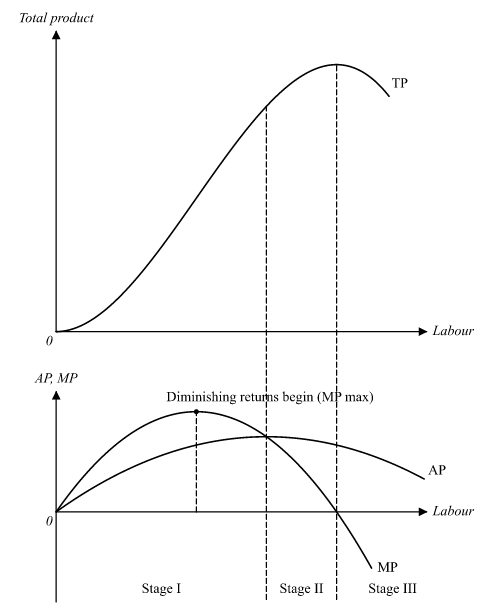
law of diminishing returns states that as more and more units of a variable factor are added to a fixed factor, the marginal product (extra output) of the variable factor may first increase but eventually decreases, other factors remaining constant
Diminishing returns set in where MP reaches its maximum and starts to fall
(b)(ii) (3 marks)Any three of:
1. At least one factor of production is fixed (e.g. land, machinery)
2. Units of the variable factor are homogeneous (equally efficient)
3. The state of technology is constant
4. It applies in the short run
5. Factors can be combined in varying proportions
6. Prices of the factors are constant
(c)(i) (1 mark)Economic development is a sustained increase in real per capita income accompanied by structural, social and institutional changes that improve the standard of living (welfare) of the people
(c)(ii) (3 marks)Any three of:
1. To raise the standard of living of the people
2. To reduce poverty
3. To create employment opportunities
4. To reduce income inequality
5. To bring about structural transformation (e.g. industrialisation)
6. To achieve economic independence / self-reliance
7. To achieve price stability and a favourable balance of payments
8. To improve infrastructure and social services (health, education, water)
9. To ensure sustainable use of resources and protect the environment
(d)(i) (1 mark)Foreign investment is the inflow of capital into a country by non-residents (foreign individuals, firms or governments) to set up or acquire productive assets (direct investment) or financial assets such as shares and bonds (portfolio investment)
(d)(ii) (3 marks)Any three of:
1. Give investment incentives such as tax holidays and duty-free import of machinery
2. Maintain political stability and security of persons and property
3. Develop infrastructure: roads, power, water, ICT (e.g. industrial parks like Namanve)
4. Guarantee investors against nationalisation (investment protection agreements)
5. Allow free repatriation of profits
6. Maintain macroeconomic stability (low inflation, stable exchange rate)
7. Widen the market through regional integration (EAC, COMESA, AfCFTA)
8. Reduce bureaucracy, e.g. a one-stop centre at the Uganda Investment Authority
9. Develop a skilled labour force
(e)(i) (2 marks)Nominal wage is the money wage paid to a worker for work done in a given period, e.g. 600,000 shillings a month
Real wage is the quantity of goods and services that the nominal wage can buy, i.e. the money wage adjusted for changes in the price level
Real wage=Consumer price indexNominal wage×100(e)(ii) (2 marks)Any two of:
1. Demand for and supply of labour
2. Productivity (efficiency) of labour
3. Cost of living
4. Bargaining strength of trade unions
5. Government wage policy (e.g. minimum wage legislation)
6. Level of skill / education and training of the worker
7. Ability of the employer to pay (profitability of the firm)
8. Nature of the job (risk, unpleasantness, responsibility)
Answer: (a) economic good scarce with a price, free good abundant with no price; (b) MP eventually falls as a variable factor is added to a fixed factor; (c) sustained rise in real per capita income with structural change; (d) capital inflow from non-residents; (e) money wage vs purchasing power of the wage
Tip: In Section A, "distinguish" needs both terms defined side by side; one line each is enough