Test Index
UACE Economics 2025 Paper 1
© africaexams.com
Question : 3
Total: 7
Solution:
What we are solving(a) Explain how an oligopolist fixes price and output (8 marks); the kinked demand curve with a diagram is expected(b) Give reasons why prices in oligopoly tend to stay the same for long periods (12 marks)Chapter: Theory of the firm (market structures)Topic: oligopoly; kinked demand curve; price rigidityKey ideasOligopoly: a market with a few large firms selling homogeneous or differentiated products, with strong interdependence and barriers to entryExamples in Uganda: telecom (MTN, Airtel), cement (Tororo Cement, Hima Cement), beer (Nile Breweries, Uganda Breweries), fuel stationsProfit is maximised where MC=MR and MC cuts MR from belowKinked demand: rivals follow a price cut but ignore a price riseModel answer(a) (8 marks)Introduction: oligopoly is a market structure with a few sellers, each of whom considers the reaction of rivals when fixing price and outputUnder non-collusive oligopoly, price and output are explained by the kinked demand curve: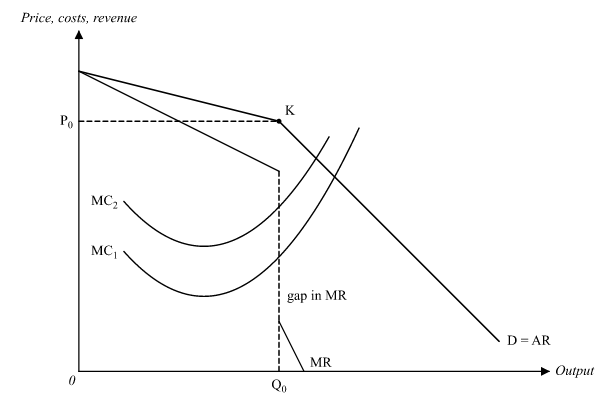 1. The firm sets its price at P0, the ruling market price, where the demand curve has a kink at K2. Above P0 demand is elastic: if the firm raises its price, rivals do not follow, so it loses many customers to them3. Below P0 demand is inelastic: if the firm lowers its price, rivals follow to protect their market share, so its sales rise only a little4. Because the demand (AR) curve has two segments, the MR curve is discontinuous, with a vertical gap directly below the kink at output Q05. The firm maximises profit where MC=MR; MC passes through the gap, so the equilibrium output is Q0 and the price is P0 (read from the AR curve at the kink)6. If MC shifts (e.g. from MC1 to MC2) but stays within the gap, price and output remain P0 and Q07. In the long run the firm can earn abnormal profits because barriers to entry keep new firms outUnder collusive oligopoly price and output are fixed by agreement: a cartel sets a common price and shares output by quotas (like a monopolist), or firms follow a price leader (the dominant or lowest-cost firm) in fixing price(b) (12 marks)Introduction: prices in oligopoly are rigid (sticky); firms prefer to keep a price once set because:1. The kinked demand curveA price rise loses customers to rivals who do not follow, and a price cut is matched by rivals, so neither raises revenue; the firm keeps price at the kink2. Discontinuous MR curveChanges in costs (MC) within the gap of the MR curve leave the profit-maximising price and output unchanged3. Fear of price warsA price cut may trigger retaliation and a price war in which all firms lose profits, so firms avoid changing price4. Collusion and cartel agreementsFirms agree on a common price (formal or tacit), and no member changes it without the others5. Price leadershipSmaller firms follow the price set by a dominant or low-cost leader and do not change it on their own6. Use of non-price competitionFirms compete through advertising, branding, promotions, after-sales services and packaging instead of price, e.g. telecom bundles and promotions7. Uncertainty about rivals' reactionsInterdependence means a firm cannot predict how rivals will respond, so it keeps the price that is known to work8. Barriers to entryFew new firms can enter, so there is no pressure from newcomers to cut prices9. Cost of changing prices (menu costs)Reprinting price lists, labels and adverts and informing distributors is expensive, so firms change prices rarely10. Brand loyalty and product differentiationCustomers attached to a brand keep buying at the ruling price, so firms need not alter it11. Desire to maintain public image and avoid government interventionFrequent price rises may attract consumer complaints or price controls and regulation, so firms keep prices stable12. Long-term contracts and fixed agreementsPrices agreed in contracts with distributors or customers cannot be changed easilyAnswer: (a) price is set at the kink K (P0); output Q0 where MC passes through the gap in MR (MC=MR); in collusion, by cartel or price leadership(b) kinked demand, gap in MR, fear of price wars, collusion, price leadership, non-price competition, uncertainty, barriers to entry, menu costs, brand loyalty, public image, contractsTip: Label the kink, the gap in MR and two MC curves through the gap; the diagram alone earns several marks in (a)
© africaexams.com
Go to Question:
Advertisements