Test Index
UACE Geography 2022 Paper 1 (Physical Geography)
© africaexams.com
Question : 4
Total: 8
Solution:
What we are solving(a) Give the differences between a delta and an estuary (10 marks)(b) Explain how one of them forms, with examples (15 marks); we explain the deltaChapter: Fluvial and coastal processesTopic: river mouths: deltas and estuariesKey ideasA delta is a low-lying, roughly triangular or fan-shaped landform of alluvium deposited at the mouth of a river where it enters a sea or lakeAn estuary is the wide, funnel-shaped, tidal mouth of a river, where fresh river water mixes with salt sea waterEast African deltas: Rufiji (Tanzania), Tana (Kenya), Semliki (into Lake Albert), Kagera (into Lake Victoria), Omo (into Lake Turkana); estuaries/drowned river mouths: Pangani and Ruvuma (Tanzania), Tudor and Port Reitz creeks at Mombasa (Kenya)Model answer(a) (10 marks)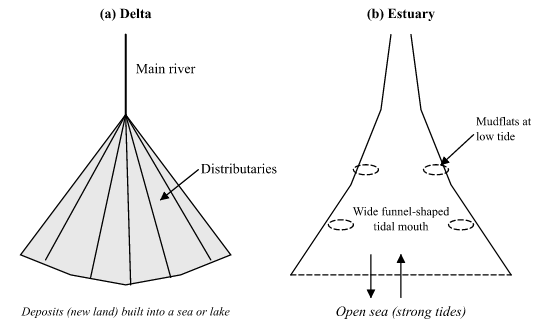 1. ProcessA delta is formed by deposition; an estuary is formed mainly by submergence/drowning of a river mouth and kept open by tidal scouring (erosion)2. Nature of the featureA delta is new land built outward into the water; an estuary is a water body (an inlet of the sea)3. ShapeA delta is triangular, fan-shaped (arcuate) or bird's-foot; an estuary is funnel-shaped, widening towards the sea4. ChannelsA delta is crossed by many distributaries; an estuary has one wide main channel5. Tides and currentsDeltas form where tides and currents are weak; estuaries form where tides and currents are strong and remove sediment6. Load of the riverDelta rivers carry a heavy load (e.g. Rufiji, Tana); estuary rivers carry little load or it is carried out to sea7. Coast/shore typeDeltas grow on shallow, gently sloping shores and in lakes; estuaries are usually on sinking (submerged) coasts with deep water8. LandformsDeltas have levees, swamps, lagoons and islands; estuaries have mudflats and salt marshes exposed at low tide9. UseDeltas give fertile alluvial farmland (rice on the Rufiji delta); estuaries make good natural harbours (Mombasa's Kilindini/Port Reitz)10. WaterDelta water is mainly fresh (river) water; estuary water is brackish (fresh and salt mixed by tides)(b) (15 marks)Formation of a delta (e.g. the Rufiji delta in Tanzania, the Tana delta in Kenya, the Semliki delta on Lake Albert).1. Large loadThe river carries a lot of alluvium from erosion in its upper course, e.g. the Rufiji drains the eroded southern Tanzanian highlands2. Sudden fall in velocityOn entering the still water of a sea or lake the river loses speed and energy, so it drops its load3. FlocculationIn salt water, fine clay particles stick together into larger lumps and sink faster4. Weak tides and currentsDeposits are not carried away, so they build up at the mouth5. Shallow, gently sloping shoreThe deposits soon reach the surface and form new land; a shallow continental shelf or lake floor helps6. Sorting of materialCoarse material is dropped first near the mouth; fine material is carried further out (bottom-set, fore-set and top-set beds)7. Blocking and branching of the channelDeposits block the main channel, so the river splits into distributaries that flow round islands of sediment8. Levees, swamps and lagoonsFlooding builds levees along the distributaries; water trapped between them forms swamps and lagoons9. Vegetation traps sedimentMangroves (Rufiji, Tana) and papyrus (Semliki, Kagera) slow the water and hold silt, so the delta grows outwards10. No lakes upstream to trap sedimentThe river reaches the mouth with its load11. Types formedArcuate (fan-shaped, e.g. Nile), bird's-foot (long distributaries, e.g. Omo into Lake Turkana) and cuspate (pointed, shaped by waves)Answer: (a) delta = depositional fan of new land with distributaries, weak tides, heavy load; estuary = drowned funnel-shaped tidal mouth with one channel, strong tides, mudflats; (b) delta forms by heavy load, loss of velocity, flocculation, weak tides, shallow shore, blocking into distributaries, levees and vegetation trapping (Rufiji, Tana, Semliki)Tip: Write each difference as one matched pair (delta ... whereas estuary ...) to earn the mark
© africaexams.com
Go to Question:
Advertisements