Test Index
UACE Geography 2022 Paper 1 (Physical Geography)
© africaexams.com
Question : 6
Total: 8
Solution:
What we are solving(a) Explain the factors that cause ocean currents (15 marks)(b) Describe how ocean currents affect the climate of nearby land (10 marks)Chapter: OceansTopic: ocean currents: causes and effectsKey ideasAn ocean current is a large mass of surface water moving in a definite directionWarm currents flow from low to high latitudes (e.g. Gulf Stream, Mozambique, Agulhas, Kuroshio); cold currents flow from high to low latitudes (e.g. Benguela, Canaries, Peru/Humboldt, Labrador)In the northern Indian Ocean the currents reverse with the monsoon winds (Somali current)Model answer(a) (15 marks)1. Planetary (prevailing) windsWinds drag surface water: the trade winds drive the North and South Equatorial currents westwards; the westerlies drive the West Wind Drift eastwards2. Seasonal winds (monsoons)In the north Indian Ocean the currents flow clockwise in the south-west monsoon and anticlockwise in the north-east monsoon3. Rotation of the earth (Coriolis force)Moving water is deflected to the right in the northern hemisphere and to the left in the southern, giving clockwise and anticlockwise gyres4. Differences in temperature (density)Warm equatorial water is light and flows over the surface towards the poles; cold polar water is dense and flows towards the equator5. Differences in salinitySaltier, denser water sinks and less salty water flows in, e.g. surface flow from the Atlantic into the Mediterranean6. Shape and position of landmassesCoastlines block and split currents, e.g. the South Equatorial current divides at Cape São Roque, and at Madagascar into the Mozambique current7. Relief of the ocean floorRidges, shelves and trenches guide or deflect deep and coastal currents8. Differences in water levelWater piled up by winds or heavy inflow of rivers and rain flows away to lower levels, e.g. the Florida current out of the Gulf of Mexico9. Melting of iceFresh, cold meltwater from the poles flows towards the equator, e.g. the Labrador and East Greenland currents10. Evaporation and precipitationHigh evaporation lowers sea level and raises salinity; heavy rain does the opposite, creating flows11. Shifting of pressure and wind belts with the sunChanges the strength and position of currents during the year(b) (10 marks)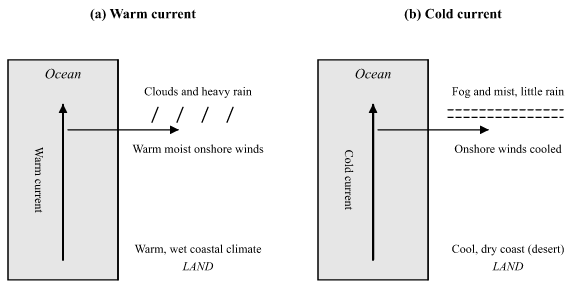 1. Warm currents raise coastal temperaturese.g. the North Atlantic Drift keeps Norway and British ports ice-free in winter2. Warm currents bring heavy rainfallOnshore winds crossing warm water pick up moisture, e.g. the Mozambique and Agulhas currents bring rain to the east coast of South Africa and Madagascar3. Cold currents lower temperaturese.g. the Labrador current makes the coast of eastern Canada very cold, freezing ports in winter4. Cold currents cause aridity and coastal desertsOnshore winds are cooled from below and become stable, so they give little rain: Namib (Benguela), Atacama (Peru), western Sahara (Canaries)5. Fog and mistWarm moist air over cold water cools and condenses, e.g. fog in the Namib and off Newfoundland where the Gulf Stream meets the Labrador current6. Reduce the range of temperatureCoasts washed by currents have a maritime climate with mild winters and cool summers7. Storms and cyclonesMeeting of warm and cold currents and very warm seas encourage storms and tropical cyclones8. Upwelling and dryness in north-east AfricaThe cold upwelling of the Somali current during the south-west monsoon contributes to the dry coast of Somalia and north-eastern Kenya9. Changes in rainfall patterns (El Niño)Warming of the Pacific currents changes rainfall in East Africa, e.g. floods in 1997–98Answer: (a) planetary winds, monsoons, earth's rotation, temperature/density, salinity, shape of land, ocean-floor relief, water-level differences, melting ice, evaporation/precipitation, shifting wind belts; (b) warm currents warm and wet the coast, cold currents cool and dry it (deserts), fog, maritime climate, storms, Somali upwelling, El NiñoTip: Give each effect with a named current and the coast it affects
© africaexams.com
Go to Question:
Advertisements