Test Index
UACE Geography 2022 Paper 3 (Uganda and Fieldwork)
© africaexams.com
Question : 3
Total: 8
Solution:
What we are solving(a) the difference between soil structure and soil texture(b) the measures being taken to conserve soils for farming in UgandaChapter: Soils of UgandaTopic: soil properties; soil conservationKey ideasSoil structure = the way individual soil particles are grouped together into lumps called aggregates (peds)Soil texture = the relative proportions of sand, silt and clay particles in a soil (the size of its particles)Soil conservation = protecting soil from erosion, exhaustion and degradation so that it stays fertile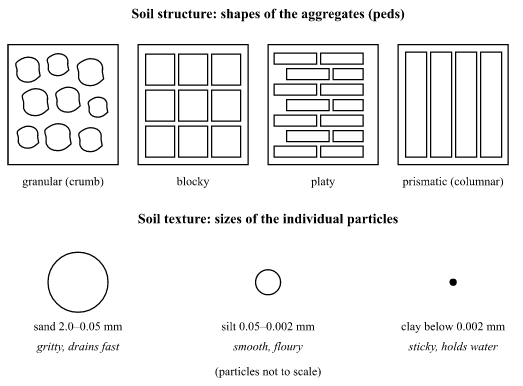 Model answer(a) (10 marks)1. Meaning: structure is the arrangement of particles into aggregates; texture is the size of the individual particles (proportions of sand, silt and clay)2. Classes: structure types are granular (crumb), blocky, platy, prismatic/columnar and single-grained; texture classes are sandy, silty, clayey and loamy soils3. How it is judged: structure is seen from the shape of the lumps in a soil profile; texture is felt by rubbing moist soil between the fingers (gritty, smooth, sticky) or by sieving and sedimentation4. Change: structure can be changed quickly by man (ploughing, compaction by animals and machines, adding manure); texture is almost permanent because it comes from the parent rock and weathering5. Causes: structure depends on humus, roots, soil organisms (earthworms, termites), wetting and drying; texture depends mainly on the parent rock and degree of weathering, e.g. sandy soils from sandstone and granite, clays from volcanic rocks and basalt6. Effects: a crumb structure gives good aeration, drainage and root penetration; texture controls water-holding capacity and nutrient retention: sand drains fast and is leached, clay holds water and nutrients but can waterlogRelationship: both control drainage, aeration and fertility, and texture influences the structure that forms (clays form blocky and prismatic structures, sands are single-grained)(b) (15 marks)1. Terracing: steps built across steep slopes slow run-off, e.g. in Kabale and Kisoro (Kigezi highlands) and on Mt Elgon slopes2. Contour ploughing and strip cropping: ridges along the contours trap water and soil, e.g. in Mbale and Bushenyi3. Mulching: covering soil with dry banana leaves and grass protects it from raindrop impact and adds humus, e.g. banana plantations in Masaka and Mukono4. Agroforestry and afforestation: trees such as grevillea and calliandra planted on farms bind soil and act as windbreaks, encouraged by the National Forestry Authority and NGOs5. Crop rotation, fallowing and intercropping: legumes such as beans and groundnuts restore nitrogen and keep the ground covered6. Use of manure and fertilisers: farmyard manure, compost and inorganic fertilisers restore lost nutrients, e.g. in the cattle corridor and Kigezi7. Controlled grazing and paddocking: limiting the number of animals prevents overgrazing and compaction in Ankole, Karamoja and Nakasongola8. Gully control and cut-off drains: stone lines, check dams and grass strips (e.g. elephant grass) stop gullies from spreading9. Planting cover crops: crops such as sweet potatoes and mucuna protect the soil surface10. Laws and bylaws: local bylaws against cultivating river banks and steep slopes; the National Environment Act enforced by NEMA11. Agricultural extension and research: NAADS, Operation Wealth Creation and NARO teach farmers soil conservation practices12. Resettlement and land-use planning: moving people from fragile steep areas, e.g. from Mt Elgon slopes after landslides in BududaConclusionStructure (how particles are grouped) and texture (how big the particles are) together decide soil quality, and Uganda is conserving its soils mainly through terracing, contour farming, mulching, agroforestry, controlled grazing and education of farmersAnswer: (a) Structure = arrangement of particles into aggregates, changeable by man; texture = proportions of sand, silt and clay, almost permanent(b) terracing, contour ploughing, mulching, agroforestry, crop rotation, manuring, controlled grazing, gully control, bylaws, extension servicesTip: In a "distinguish" question, give each difference as a pair (structure ... whereas texture ...)
© africaexams.com
Go to Question:
Advertisements