Test Index
UACE Geography 2024 Paper 1 (Physical Geography)
© africaexams.com
Question : 4
Total: 8
Solution:
What we are solving(a) examine the chemical weathering processes in the hot, wet (humid) parts of East Africa(b) describe the landforms produced by chemical weathering in East AfricaChapter: WeatheringTopic: chemical weathering processes and landformsKey ideasChemical weathering is the decomposition of rocks in place by chemical reactions between rock minerals and water, oxygen, carbon dioxide and organic acidsIt is fastest where it is hot and wet: every 10∘C rise roughly doubles the rate of reactionHumid areas: the Lake Victoria basin, Buganda, the slopes of Mt Elgon and Rwenzori, the East African coastModel answer(a) (10 marks)Introduction: in humid East Africa, high temperatures (over 20∘C) and heavy rain (over 1,500 mm) make chemical weathering dominant, giving deep regolith1. HydrolysisWater reacts with feldspars in granite and gneiss, turning them into clay (kaolinite)This rots granite deeply, e.g. in Buganda and around Lake Victoria2. OxidationOxygen in water reacts with iron minerals, forming red iron oxidesThis gives the red soils and laterite (murram) of Buganda3. CarbonationRain water with dissolved CO2 forms weak carbonic acid that dissolves limestoneCaCO3+H2O+CO2→Ca(HCO3)2e.g. coral limestone at the coast, limestone at Hima4. SolutionSoluble minerals such as rock salt and gypsum dissolve directly in water and are carried away5. HydrationMinerals absorb water and swell, e.g. haematite → limonite, anhydrite → gypsumThe swelling weakens and breaks the rock6. Chelation (biological weathering by organic acids)Humic acids from decaying vegetation in thick forests (Mabira, Budongo) dissolve and remove metal ions from rocks7. ReductionIn waterlogged swamps without oxygen, iron is reduced to grey-blue compounds (gleying), e.g. papyrus swamps of Kigezi and Lake Kyoga(b) (15 marks)Introduction: landforms of chemical weathering result from deep, uneven rotting of rock followed by removal of the weathered material1. TorsPiles of rounded granite blocks (corestones) standing on hill topsFormed by deep weathering along joints, then stripping of the regolithe.g. Bismarck rock and the tors around Mwanza; tors in Teso2. Inselbergs (bornhardts)Steep-sided, dome-shaped rock hills rising abruptly from plainsMassive, widely jointed rock resists weathering while the surrounding rock rots and is removede.g. Nyero rocks (Kumi), Soroti rock, inselbergs of Dodoma3. Deep regolithA thick mantle of rotted rock up to 30 m or more, e.g. in Buganda and the Lake Victoria basin4. Laterite (duricrust) capped hillsIron and aluminium oxides concentrate and harden into a crust (murram)This protects hill tops, giving the flat-topped hills of Buganda5. Limestone caves and cavernsCarbonation enlarges joints into underground cavese.g. Amboni caves (Tanga), Shimoni caves (Kenya coast)6. Stalactites and stalagmitesCalcium carbonate is re-deposited from dripping water in caves, e.g. in the Amboni caves7. Swallow holes, sinkholes and dolinesSurface depressions where solution has widened joints in limestone and water disappears underground8. Weathering pits and pansShallow hollows on bare granite surfaces where water collects and rots the rock, e.g. on inselbergs in Teso9. Exfoliation / spheroidal weathering formsRounded boulders formed as chemical weathering attacks corners and edges of jointed blocks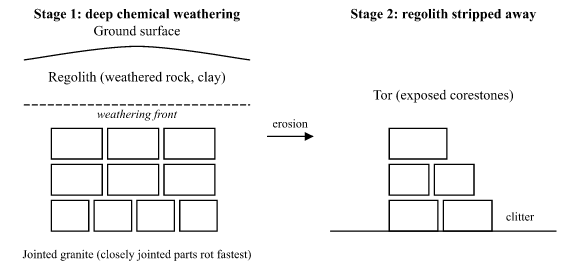 ConclusionHydrolysis, oxidation and carbonation dominate in humid East AfricaThey produce tors, inselbergs, deep regolith, laterite-capped hills and limestone cave landscapesAnswer: (a) hydrolysis, oxidation, carbonation, solution, hydration, chelation, reduction; (b) tors, inselbergs, deep regolith, laterite hills, caves, stalactites/stalagmites, sinkholes, weathering pits, rounded bouldersTip: Name the rock attacked and an East African place for each process
© africaexams.com
Go to Question:
Advertisements