Test Index
UACE Geography 2024 Paper 1 (Physical Geography)
© africaexams.com
Question : 3
Total: 8
Solution:
What we are solving(a) explain how existing rocks are changed into metamorphic rocks(b) examine how rocks have helped the development of East Africa, with named examplesChapter: Rocks (lithosphere)Topic: metamorphic rocks; economic importance of rocksKey ideasMetamorphism is the change in form, texture and mineral composition of an existing rock (igneous, sedimentary or metamorphic) by great heat, pressure or chemically active fluids, without meltingExamples: limestone → marble; shale → slate → schist; sandstone → quartzite; granite → gneiss; coal → graphiteEast Africa's Basement Complex (gneisses, schists, quartzites) covers much of Uganda, Kenya and TanzaniaModel answer(a) (15 marks)Introduction: metamorphic rocks form when heat, pressure and fluids alter rocks deep in the crust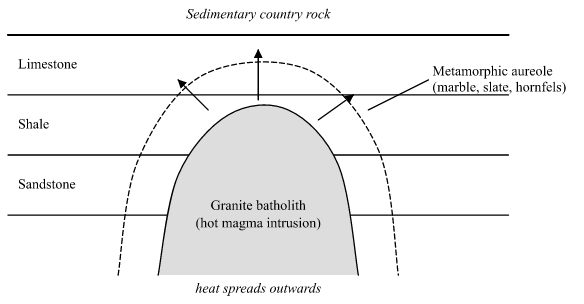 1. Thermal (contact) metamorphismHot magma intruding as a batholith, dyke or sill bakes the surrounding country rockA ring of changed rock, the metamorphic aureole, formse.g. limestone → marble, shale → hornfels2. Regional metamorphismDuring mountain building (orogeny) huge areas are buried, folded and heatedHeat and pressure together recrystallise the rock, e.g. shale → slate → schist → gneisse.g. the Basement Complex gneisses of central and northern Uganda3. Dynamic (cataclastic) metamorphismGreat directed pressure along faults and thrust zones crushes and shears rockThis forms mylonite and foliated rocks, e.g. along the Rift Valley faults4. Pressure from deep burial (load metamorphism)The weight of thick overlying layers compacts and recrystallises rocks at depthe.g. clay/shale becoming slate5. RecrystallisationUnder heat and pressure the minerals re-form into larger, interlocking crystalse.g. calcite grains of limestone grow into the crystals of marble6. Foliation (re-alignment of minerals)Pressure lines up flat minerals such as mica at right angles to the stressThis gives slaty cleavage, schistosity and the banding of gneiss7. Metasomatism (chemical replacement)Hot, chemically active fluids and gases from magma add or remove elementsNew minerals form, e.g. ore minerals in contact zones8. Hydrothermal actionHot water circulating through cracks changes minerals, e.g. feldspar into clay or serpentineIt also deposits mineral veins (gold, copper)(b) (10 marks)1. Source of minerals for miningCopper and cobalt at Kilembe (Kasese), gold at Busia and Geita, diamonds from the kimberlite pipe at Mwadui (Tanzania)They earn foreign exchange and create jobs2. Raw materials for cementLimestone at Hima (Kasese) and Tororo, coral limestone at Bamburi (Mombasa), marble in KaramojaThey supply the construction industry3. Building and construction materialsGranite and gneiss are quarried for stone aggregate (e.g. quarries around Kampala), plus sand, murram and clay for bricks and tiles4. Fertile soils for agricultureVolcanic rocks weather into rich soils on Mt Elgon, the Kenya highlands and KigeziThey support coffee, tea, bananas and horticulture5. FertilisersPhosphate rocks at Sukulu hills (Tororo) and Minjingu (Tanzania) are used for fertiliser6. Oil and gasSedimentary rocks of the Albertine Graben hold oil (Lake Albert region); gas at Songo Songo (Tanzania)7. Geothermal energyHot volcanic rocks at Olkaria (Kenya) produce geothermal power8. TourismRock landscapes attract tourists: inselbergs and tors (Nyero rocks, Kumi), Mt Kilimanjaro, Mt Elgon caves, rock paintings9. Water supplyPorous and fractured rocks store groundwater (aquifers) tapped by boreholes in dry areas such as Karamoja10. Limitations (to examine fairly)Hard rocks raise the cost of roads and buildings; quartzite ridges give thin, infertile soils; quarrying damages landConclusionMetamorphic rocks form mainly by heat, pressure and chemical fluids that recrystallise and re-align mineralsRocks contribute greatly to East Africa's development through minerals, cement, construction materials, soils, energy and tourism, despite a few limitationsAnswer: (a) contact, regional, dynamic and load metamorphism, recrystallisation, foliation, metasomatism, hydrothermal action; (b) minerals, cement, building materials, soils, fertilisers, oil, geothermal energy, tourism, groundwaterTip: Give a named East African example with every point
© africaexams.com
Go to Question:
Advertisements