Test Index
UACE Geography 2024 Paper 1 (Physical Geography)
© africaexams.com
Question : 8
Total: 8
Solution:
What we are solving(a) show the differences between zonal and intra-zonal soils(b) suggest soil conservation measures, each with a specific East African areaChapter: SoilsTopic: soil classification; soil conservationKey ideasZonal soils: mature, well-developed soils whose properties are controlled mainly by the climate and vegetation of a large zoneIntra-zonal soils: mature soils whose properties are controlled mainly by a local factor (bad drainage, parent rock, salts) that overrides climate(Azonal soils, by contrast, are young and immature)Model answer(a) (10 marks)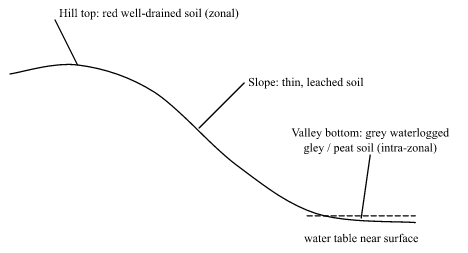 1. Main controlling factorZonal: climate and natural vegetationIntra-zonal: local factors such as drainage, parent rock or salts2. ExtentZonal: cover large, continuous regions (climatic zones)Intra-zonal: occur in small patches within a zone3. DrainageZonal: usually well drainedIntra-zonal: often poorly drained (waterlogged) or affected by evaporation of salts4. ProfileZonal: deep with clear A, B and C horizonsIntra-zonal: horizons are modified, e.g. a grey gley layer or a salt crust5. ExamplesZonal: latosols (red ferralitic soils) of Buganda and the Lake Victoria basin; chestnut soils of semi-arid areasIntra-zonal: hydromorphic peat and gley soils in Kigezi and Lake Kyoga swamps; halomorphic (saline) soils around Lake Magadi and Natron; calcimorphic rendzinas on coastal limestone6. PositionZonal: on well-drained uplands and gentle slopesIntra-zonal: on valley bottoms, swamps, lake shores and over special rocks(b) (15 marks)1. TerracingSteps cut across steep slopes slow run-offe.g. Kigezi (Kabale), Mt Elgon (Bugisu), the Usambara and Uluguru mountains2. Contour ploughing and strip croppingPloughing and planting along contours checks water flowe.g. Mbale and the Kenya highlands3. Afforestation and re-afforestationTree roots bind soil and canopies break raindropse.g. re-planting in Mabira and on Kigezi hills4. MulchingCovering soil with banana leaves and grass protects it from rain splash and keeps moisturee.g. banana gardens of Buganda and Masaka5. Crop rotation, fallowing and cover cropsKeep the soil covered and maintain fertilitye.g. Teso and Lango6. Controlled grazing and destockingPaddocking and keeping animals within carrying capacity prevent overgrazinge.g. Ankole–Masaka ranches, Karamoja, Maasailand7. Gabions, check dams and grass bundsTrap soil and stop gullies growinge.g. gully control in Kabale; fanya juu terraces in Machakos (Kenya)8. Use of manure and fertilisersRestore lost nutrients and improve soil structuree.g. coffee and tea farms in Bushenyi and Kericho9. AgroforestryPlanting trees among crops (e.g. Grevillea in Kenya highlands, Mt Elgon coffee shade trees)10. Stopping bush burningBurning destroys cover and organic mattere.g. bye-laws in northern Uganda11. Resettlement to relieve population pressuree.g. moving people from crowded Kigezi to Kibaale and Bunyoro12. Education and lawsExtension services, NEMA regulations, protection of wetlands and steep slopesConclusionZonal soils reflect climate and vegetation over wide areas, intra-zonal soils reflect local drainage, rock or salt conditionsA mix of physical (terraces, bunds), biological (trees, mulch) and management (grazing control, laws) measures conserves soil bestAnswer: (a) zonal: climate-controlled, extensive, well drained, deep horizons (latosols); intra-zonal: local factors, patchy, waterlogged/saline (gley, peat, saline soils); (b) terracing, contour ploughing, afforestation, mulching, rotation, controlled grazing, gabions, manure, agroforestry, no bush burning, resettlement, education/lawsTip: Pair every conservation measure with a named place
© africaexams.com
Go to Question:
Advertisements