What we are solvingReflection and refraction: diffuse reflection, deviation by a small-angle prism, the minimum deviation experiment, a fish's view and an apparent depth problem
Given for (e): oil layer 5 cm thick on 8 cm of water (
nw=1.33); the bottom appears 9.5 cm below the top of the oil
Chapter: Geometrical optics
Topic: Reflection, refraction through prisms, real and apparent depth
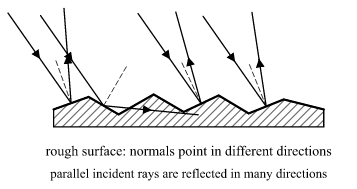
(a) (2 marks)Diffuse (irregular) reflection happens at a rough surface such as paper or a wall
Each ray still obeys the laws of reflection at the tiny part of the surface it strikes
But the normals at the different points point in different directions
So a parallel incident beam is reflected in many directions (scattered), and no clear image is formed
(b) (5 marks)Let the prism have angle
A and refractive index
n; a ray enters at angle
i1 (refracted at
r1) and leaves at angle
i2 (inside angle
r2)
Geometry of the prism:
r1+r2=ATotal deviation (sum of the deviations at the two faces):
D=(i1−r1)+(i2−r2)=i1+i2−AFor small angles,
sinθ≈θ (in radians), so Snell's law
sini=nsinr becomes
i1=nr1,i2=nr2Substituting:
D=nr1+nr2−A=n(r1+r2)−A=nA−AD=(n−1)ASo
D depends only on the prism angle
A and the refractive index
n, not on the angle of incidence
(c) (5 marks)Place the prism on a plain sheet of paper fixed on a soft board and trace its outline ABC; remove the prism
Draw a normal at a point on face AB and a line making an angle of incidence
i (e.g.
30∘) with it
Fix two pins
P1 and
P2 upright on this incident line and replace the prism on its outline
Looking through face AC, fix pins
P3 and
P4 so that they appear in line with the images of
P1 and
P2Remove the prism, join
P3P4 (emergent ray) and produce it back to meet the incident line produced; measure the angle of deviation
DRepeat for other angles of incidence (e.g.
35∘ to
70∘) and tabulate
i and
DPlot
D against
i: the curve falls to a minimum and rises again; the lowest value of
D is the angle of minimum deviation
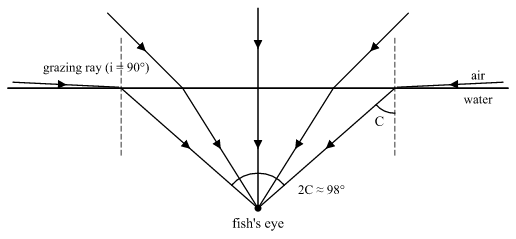
Dmin(d) (4 marks)Light from objects above the water reaches the fish after refraction at the water surface
Rays from the sky strike the surface at angles of incidence from
0∘ up to
90∘ (grazing rays)
On entering the denser water they bend towards the normal; even a grazing ray (
i=90∘) is refracted at the critical angle
C:
sinC=n1=1.331 ⇒ C=48.8∘So the whole
180∘ view above the water reaches the eye inside a cone of angle
2C≈98∘The fish therefore sees everything above the water, from horizon to horizon, squeezed into this cone: it has a very wide field of view (objects near the horizon look distorted)
(e) (4 marks)Viewed from directly above, each layer makes the bottom look nearer by its own amount
apparent depth=nreal depthThe apparent depths of the two layers add:
no5+1.338=9.51.338=6.015 cmno5=9.5−6.015=3.485 cmno=3.4855=1.43Refractive index of the oil
=1.43Answer: (b)
D=(n−1)A; (d) all the sky is seen within a cone of
2C≈98∘; (e)
noil=1.43Tip: In (e) work layer by layer: apparent depth of a stack = sum of (thickness / n) of each layer