What we are solvingLenses: focal length, the displacement method
l2−d2=4lf, a magnifying-glass ray diagram, a lens on a mirror and on mercury, the eye and a compound microscope
Given for (c): pin coincides with its image 20.0 cm above the lens on a mirror and 7.0 cm above it on mercury
Given for (e): focal lengths 1.2 cm and 4.0 cm; object 1.5 cm from the objective; normal adjustment
Chapter: Geometrical optics
Topic: Thin lenses, the eye and optical instruments
(a) (1 mark)Focal length of a lens: the distance between the optical centre of the lens and its principal focus
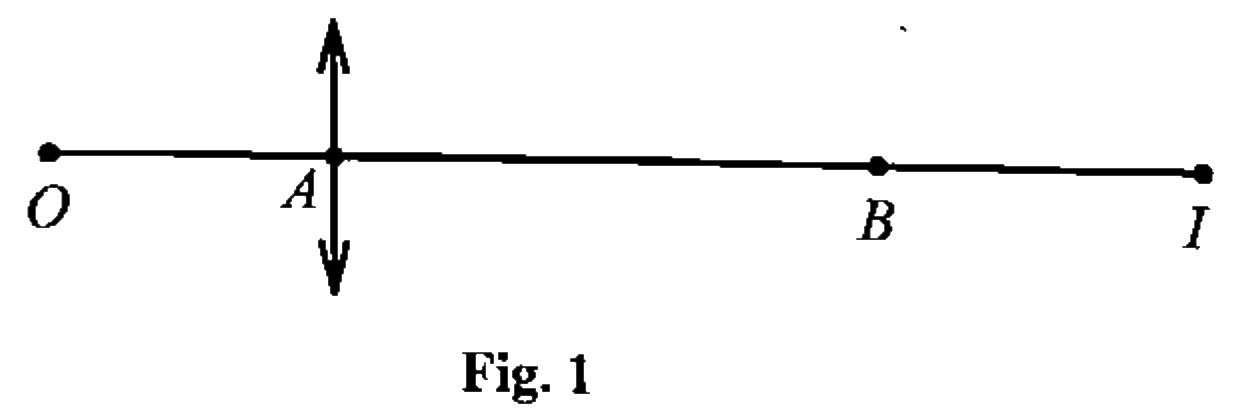
(b)(i) (5 marks)Let the first position of the lens be at A with object distance
u1=OA and image distance
v1=AIu1+v1=lBy the principle of reversibility of light, the second sharp image (lens at B) occurs when object and image distances are interchanged:
u2=v1,v2=u1So the lens moves a distance
d=AB=v1−u1Solving the two equations:
u1=2l−d,v1=2l+dLens formula:
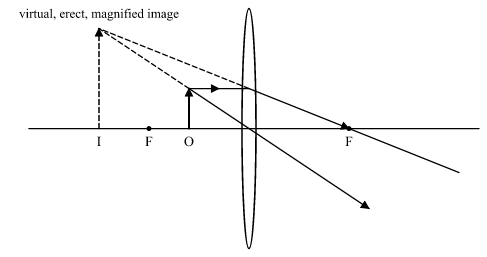
f1=u11+v11=l−d2+l+d2=l2−d24ll2−d2=4lf(b)(ii) (2 marks)Object O placed between the lens and its principal focus F
Ray 1: parallel to the axis, refracted through F on the other side
Ray 2: through the optical centre, undeviated
The refracted rays diverge; produced backwards (dashed) they meet at I on the same side as the object
(b)(iii) (2 marks)The image is virtual, erect (upright) and magnified
It is on the same side of the lens as the object, further from the lens than the object
(c) (4 marks)On the plane mirror: the rays return along their own paths only if they leave the lens parallel, so the pin is at the principal focus
f=20.0 cmOn mercury, the mercury fits the curved lower surface and makes it a concave mirror; the pin coincides with its image when the rays inside the glass strike this curved surface normally, i.e. head along radii towards its centre of curvature
Rays from the pin at height
h refract at the flat top face and appear to come from a height
nh; this must be the radius of curvature
r:
r=nh=7.0nLens maker's formula for a plano-convex lens:
f1=(n−1)r1 ⇒ r=(n−1)f=20(n−1)Equating the two expressions for
r:
7.0n=20n−20 ⇒ 13n=20 ⇒ n=1.54r=7.0×1.538=10.8 cmRadius of curvature of the lens
≈10.8 cm
(d)(i) (1 mark)Near point: the nearest point to the eye at which an object can be seen clearly (distinctly) without strain (about 25 cm for a normal eye)
(d)(ii) (1 mark)Accommodation: the ability of the eye to change the focal length of its lens (by the ciliary muscles changing its thickness) so that objects at different distances are focused on the retina
(e) (4 marks)The objective is the lens of shorter focal length,
fo=1.2 cm; the eyepiece has
fe=4.0 cm
Image by the objective (real-is-positive):
vo1=fo1−uo1=1.21−1.51=1.81.5−1.2=61vo=6.0 cmNormal adjustment: the final image is at infinity, so this intermediate image lies at the principal focus of the eyepiece, 4.0 cm from it
separation=vo+fe=6.0+4.0=10.0 cmAnswer: (b)(i)
l2−d2=4lf; (c)
r≈10.8 cm (
n=1.54); (e) lenses 10.0 cm apart
Tip: In normal adjustment the eyepiece's object is always at its focus; add
fe to the objective's image distance