What we are solvingProgressive and stationary waves from the equation
y=20sin(300πt−15πx) (
x in cm), modes in a closed pipe, and beats
Chapter: Waves
Topic: Progressive and stationary waves; sound in pipes; beats
(a)(i) (1 mark)A progressive wave is a wave in which the disturbance (wave profile) moves away from the source through the medium, carrying energy from one point to another
(a)(ii) (3 marks)All particles vibrate with the same amplitude and the same frequency
The phase changes progressively from one particle to the next along the direction of travel
Energy is transferred in the direction in which the wave travels
The wave profile moves with a constant speed
v=fλ in a given medium
(b)(i) (1 mark)A wave of the same amplitude and frequency travelling in the opposite direction (the
x term changes sign):
y2=20sin(300πt+15πx)(b)(ii) (4 marks)By the principle of superposition
y=y1+y2sinP+sinQ=2sin2P+Qcos2P−QWith
P=300πt−15πx and
Q=300πt+15πx:
2P+Q=300πt,2P−Q=−15πxy=40cos(15πx)sin(300πt)Amplitude at a point
x:
40cos(15πx); it varies with position, with a maximum value of 40 units (at the antinodes)
(b)(iii) (2 marks)Compare
cos(kx) with
cos(15πx):
k=λ2π=15πλ=30 cm(adjacent nodes are
λ/2=15 cm apart)
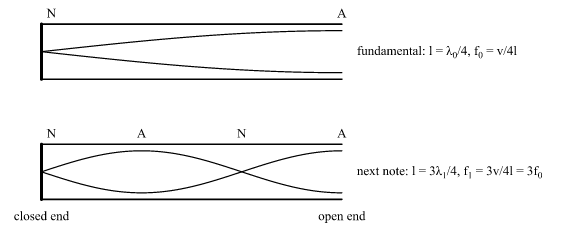
(b)(iv) (2 marks)ϕ=λ2πΔxϕ=302π×25=35π rad (=300∘)(c) (4 marks)In a pipe closed at one end there is always a node N at the closed end and an antinode A at the open end (end correction ignored)
Fundamental: the shortest arrangement N to A, so
l=4λ0 ⇒ f0=λ0v=4lvNext possible note: N A N A, so
l=43λ1 ⇒ f1=λ1v=4l3v=3f0Key point: a closed pipe gives only odd harmonics; the note
3f0 is the first overtone (the third harmonic). It is the second note the pipe can sound, which is what the question calls the second harmonic
(d) (3 marks)Sound the note of unknown frequency
f together with a tuning fork of known frequency
fs close to it
Count the number of beats
n heard in a measured time
t; beat frequency
fb=tn, so
f=fs±fbLoad the known fork with a little plasticine (lowers
fs) and sound them again: if the beat frequency increases,
f=fs−fb; if it decreases,
f=fs+fbAnswer: (b)(i)
y2=20sin(300πt+15πx); (b)(ii)
y=40cos15πxsin300πt, maximum amplitude 40; (b)(iii)
λ=30 cm; (b)(iv)
35π rad
Tip: Read
k and
ω straight from the equation:
k=2π/λ and
ω=2πf (here
f=150 Hz)