What we are solvingWave optics: Huygens' principle and refraction from glass into air, polarisation by reflection, interference and Newton's rings, Lloyd's mirror
Given for (a)(iii): liquid
n=34, glass
n=1.52; reflected light completely plane polarised
Given for (c): source and its image 6.0 mm apart, 15 cm from the left edge of a 36 cm mirror, screen at the right edge,
λ=600 nm
Chapter: Wave optics
Topic: Huygens' principle, polarisation, interference
(a)(i) (1 mark)Huygens' principle: every point on a wavefront acts as a source of secondary wavelets that spread out with the speed of the wave; the new wavefront is the surface touching (the envelope of) all these wavelets
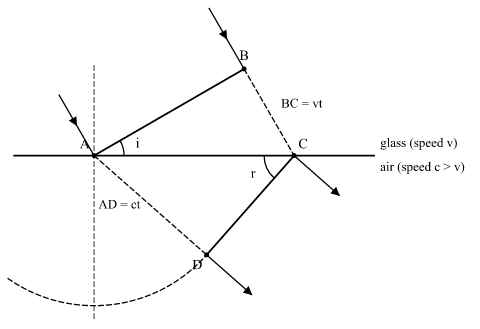
(a)(ii) (3 marks)Let AB be a plane wavefront in glass meeting the boundary obliquely; A touches the boundary first
In the time
t that the disturbance at B travels
BC=vt in glass to reach the boundary at C, the wavelet from A travels into air with radius
AD=ctSince light is faster in air (
c>v),
AD>BCThe tangent from C to the wavelet centred at A gives the refracted wavefront CD
Because
AD>BC the wavefront turns, and the ray is bent away from the normal:
sinrsini=ADBC=cv(a)(iii) (4 marks)Reflected light is completely plane polarised when the angle of incidence is the polarising (Brewster) angle
θp:
tanθp=n1n2=4/31.52=1.14θp=48.7∘At this angle the reflected and refracted rays are at right angles:
θp+r=90∘ ⇒ r=90∘−48.7∘=41.3∘Check with Snell's law:
34sin48.7∘=1.002 and
1.52sin41.3∘=1.003Angle of refraction in the glass
≈41.3∘(b)(i) (1 mark)Interference: the superposition of light waves from two coherent sources, giving a pattern of alternate bright (reinforcement) and dark (cancellation) fringes
(b)(ii) (1 mark)Path difference: the difference between the distances travelled by the two waves from their sources to the point where they meet
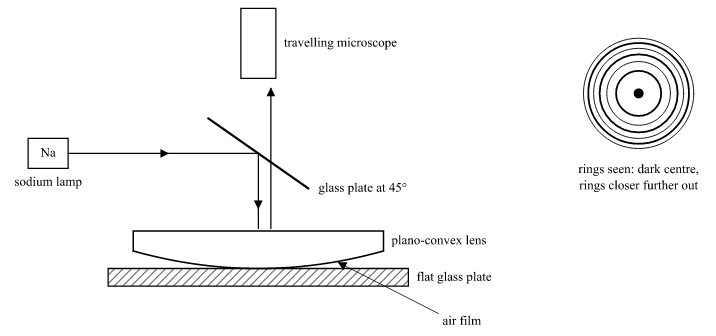
(b)(iii) (6 marks)A plano-convex lens of large radius of curvature rests with its curved face on a flat glass plate, enclosing a thin air film
Light from a sodium lamp (monochromatic) is reflected down onto the lens by a glass plate at
45∘ and the film is viewed from above through a travelling microscope
Light reflected from the lower (curved) surface of the lens and from the top of the flat plate interfere
At a place where the film thickness is
t, the path difference is
2t, and reflection at the glass plate (air to glass) adds a phase change of
πDark fringe:
2t=mλ; bright fringe:
2t=(m+21)λThe thickness is the same all round any circle centred on the point of contact, so the fringes are concentric circles (rings)
At the centre
t=0, but the
π phase change makes it dark
The film thickness grows faster further out (
t≈2Rr2), so the rings get closer together away from the centre
(c) (3 marks)The source
S0 and its image act as two coherent sources, separation
a=6.0×10⁻³ m
Distance from the sources to the screen:
D=15+36=51 cm
=0.51 m
Reflection at the mirror adds a phase change of
π, so the point where the mirror meets the screen (zero path difference) is dark
The first bright fringe is where the path difference is
2λ:
Day=2λ ⇒ y=2aλDy=2×6.0×10−3600×10−9×0.51=2.55×10⁻⁵ mThe first maximum is
2.55×10⁻⁵ m (0.026 mm) from the right edge of the mirror
(d) (1 mark)Any one: testing the flatness of surfaces (optical flats); blooming (anti-reflection coating) of lenses; measuring the wavelength of light; measuring the thickness of thin films
Answer: (a)(iii)
r≈41.3∘; (c)
2.55×10⁻⁵ m from the right edge
Tip: In Lloyd's mirror the fringe at the mirror edge is dark because of the
π phase change on reflection