What we are solvingMagnetic effect of a current: definitions, the field at the centre of a coil, a current balance, an experiment, the torque on a coil, and the force on a moving electron
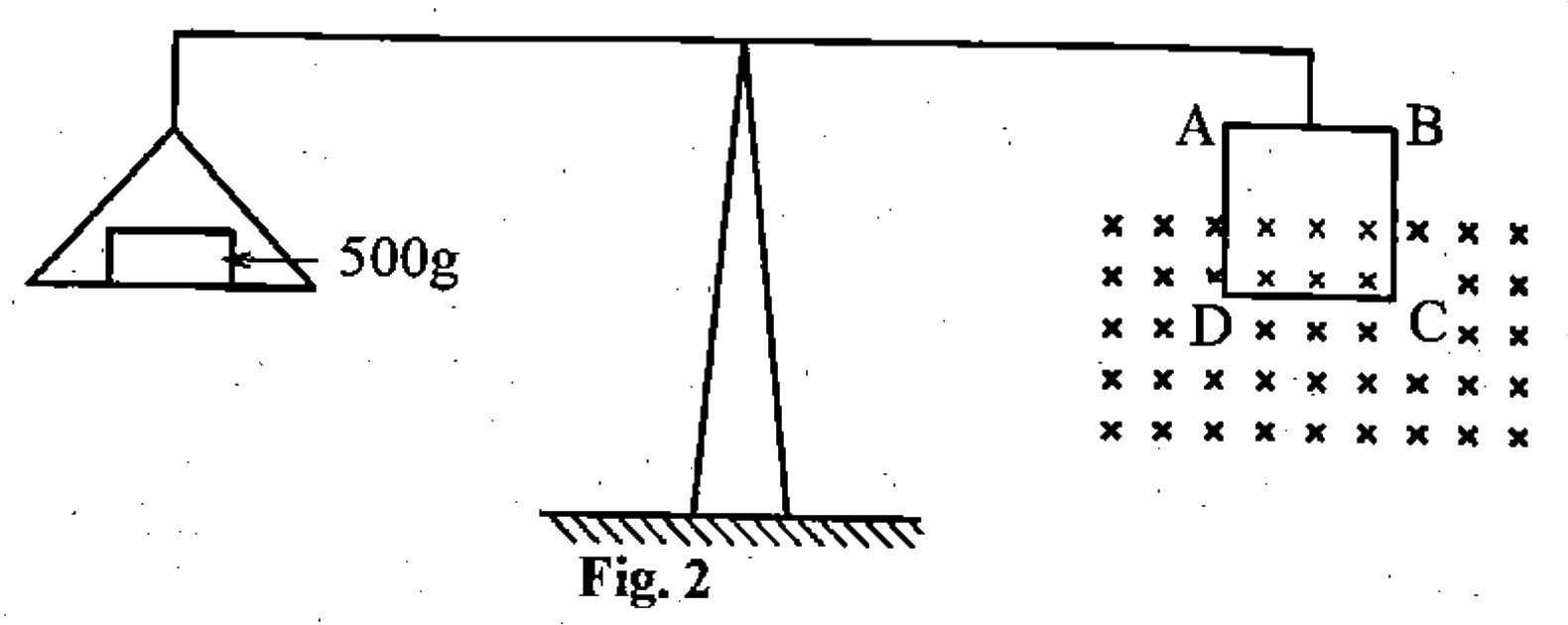
Given for (c): square coil of side 1.0 m, 100 turns, side CD in
B=0.2 T,
I=9.8 A
Given for (e)(ii): electron at
107 m s−1, 2 cm from a wire carrying 10 A
Chapter: Magnetic effect of an electric current
Topic: Magnetic flux density; forces and torques on conductors
(a)(i) (1 mark)Magnetic flux density is the force acting on a conductor of length 1 m carrying a current of 1 A placed at right angles to the magnetic field (
B=ILF)
(a)(ii) (1 mark)The tesla is the flux density of a uniform magnetic field in which a conductor 1 m long carrying a current of 1 A at right angles to the field experiences a force of 1 N
(b)(i) (3 marks)Let each turn have radius
r; the wire of length
x makes
N turns:
x=N×2πr ⇒ r=2πNxFlux density at the centre of a flat coil of
N turns:
B=2rμ0NIB=2μ0NI×x2πN=xμ0πN2I(b)(ii) (1 mark)By the right-hand grip rule, a clockwise current (as seen by the observer) gives a field at the centre directed into the plane of the coil, away from the observer
(c) (2 marks)Only side CD is in the field; the forces on the vertical parts of AD and BC in the field are equal and opposite and cancel
Force on CD (taken downwards for the current direction used):
F=NBIL=100×0.2×9.8×1.0=196 NThe arms of the balance are equal, so the extra mass
m on the pan must have weight
F:
m=gF=9.81196=20.0 kgAbout 20 kg must be added to the 500 g
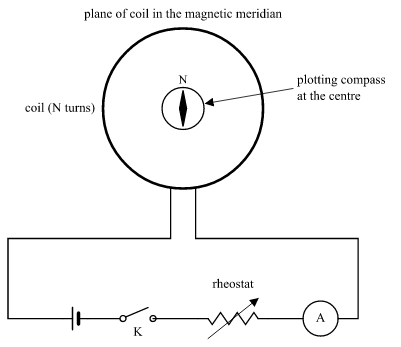
(d) (6 marks)Set the plane of a vertical circular coil in the magnetic meridian (N–S) and place a small plotting compass at its centre
Connect the coil in series with a battery, key, rheostat and ammeter
With no current the needle points along the meridian (earth's horizontal field
BE)
Close the key: the coil's field
B at the centre is at right angles to
BE, and the needle turns through an angle
θ where
tanθ=BEBRecord the current
I and the deflection
θ (read both ends of the needle; reverse the current and take the mean)
Adjust the rheostat to get several values of
I and the corresponding
θPlot
tanθ against
I: a straight line through the origin shows
B∝I(Repeating with coils of different numbers of turns, same current, shows
B∝N)
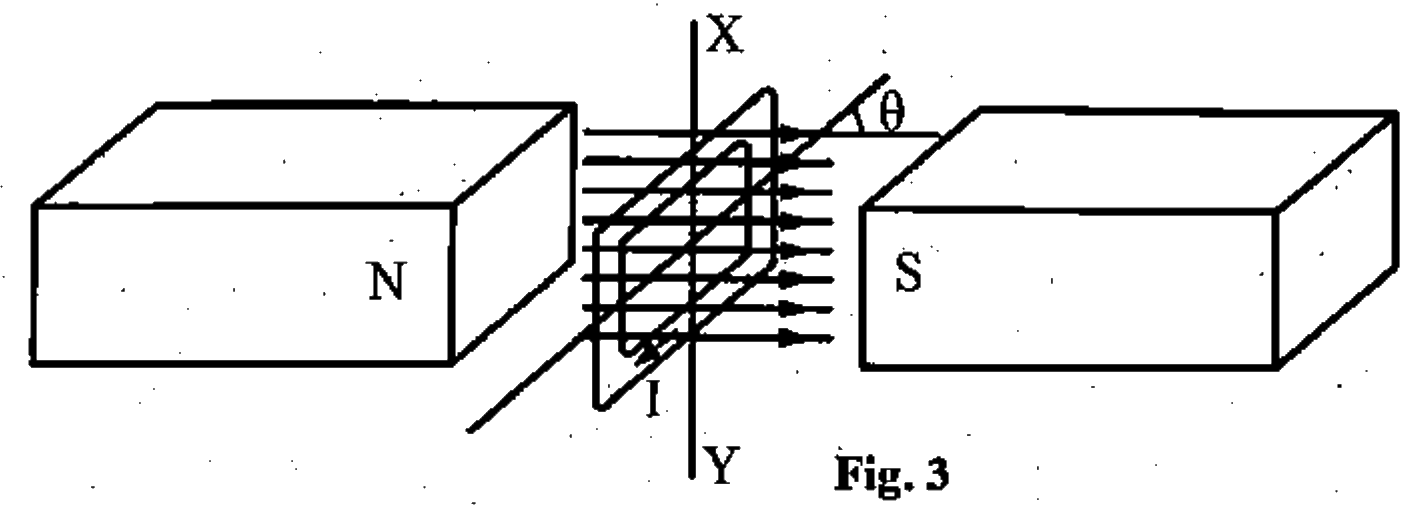
(e)(i) (4 marks)Let the coil have sides
a (parallel to the axis XY) and
b, so
A=abEach side parallel to the axis is at right angles to
B and has force
F=BINaThe two forces are equal, opposite and parallel (a couple); the forces on the other two sides act along the axis and cancel
When the plane of the coil makes angle
θ with the field, the perpendicular distance between the two forces is
bcosθτ=F×bcosθ=BINabcosθτ=BANIcosθ(e)(ii) (2 marks)Field of the long straight wire at 2 cm:
B=2πrμ0I=2π×0.024π×10−7×10=1.0×10⁻⁴ TForce on the electron moving at right angles to
B (e.g. parallel to the wire):
F=Bev=1.0×10−4×1.6×10−19×107=1.6×10⁻¹⁶ NAnswer: (b)(i)
B=xμ0πN2I; (b)(ii) into the plane of the coil; (c) about 20 kg; (e)(i)
τ=BANIcosθ; (e)(ii)
1.6×10⁻¹⁶ N
Tip: Check (c) with
g=9.8: the numbers were chosen so the answer is exactly 20 kg