What we are solvingElectromagnetic induction: mutual induction, transformer core losses, the e.m.f of a rotating disc, a rod falling between rails, and the moving coil loudspeaker
Given for (d): rod 0.5 m, resistance
0.04 Ω, mass 0.03 kg,
B=0.2 T
Chapter: Electromagnetic induction
Topic: Induced e.m.f, eddy currents and applications
(a)(i) (1 mark)Mutual induction is the production of an e.m.f in one coil when the current (and so the magnetic flux) in a neighbouring coil linked with it changes
(a)(ii) (2 marks)Wind two coils on a soft iron rod; connect the primary to a battery and a switch, and the secondary to a centre-zero galvanometer
On closing the switch the galvanometer deflects briefly; on opening it, it deflects briefly the other way; with a steady current there is no deflection. An e.m.f is induced in the secondary only while the primary current changes
(b) (2 marks)Eddy current loss is reduced by laminating the core: thin sheets of soft iron insulated from one another raise the resistance to eddy currents
Hysteresis loss is reduced by making the core of soft iron (or special alloy), which is easily magnetised and demagnetised
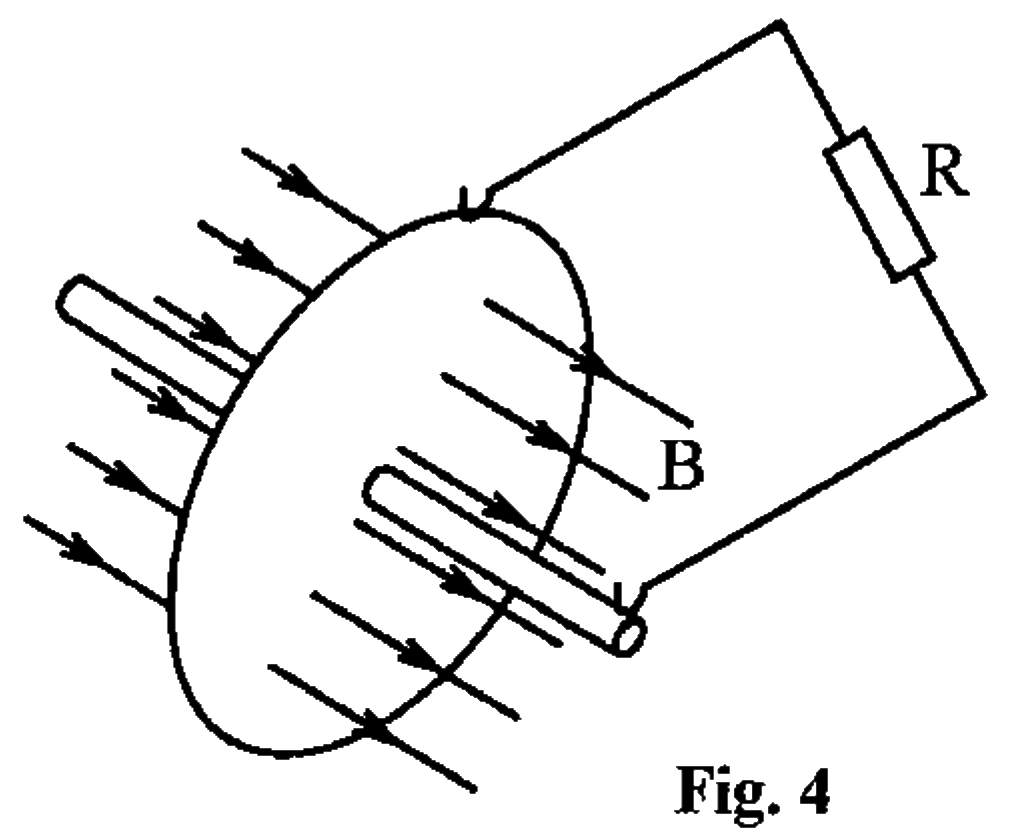
(c) (3 marks)A radius of the disc cuts the magnetic flux as the disc turns; in one revolution it sweeps the whole area
πr2Time for one revolution:
T=ω2πE=timeflux cut=2π/ωBπr2E=21Bωr2(the current in the circuit is then
I=2RBωr2)
(d)(i) (3 marks)As the rod falls it cuts the magnetic flux, so an e.m.f
E=BLv is induced and a current
I=RBLv flows round the rod, rails and top wire
The current-carrying rod in the field feels a force
BIL which, by Lenz's law, acts upwards, opposing the fall
This force grows as the speed grows; when it equals the weight
mg the resultant force is zero, so the acceleration is zero and the rod moves with a steady (terminal) velocity
(d)(ii) (4 marks)At steady velocity the magnetic force balances the weight:
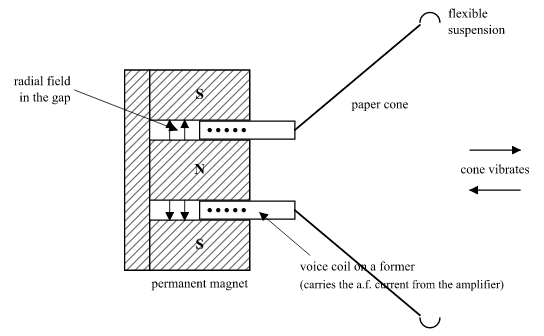
BIL=mg,I=RBLvRB2L2v=mg ⇒ v=B2L2mgRv=0.22×0.520.03×9.81×0.04=0.010.011772=1.18 m s−1(e) (5 marks)Structure: a cylindrical permanent magnet with a central pole and a surrounding ring pole gives a strong radial field in the gap
A light coil (voice coil) wound on a cylindrical former sits in the gap and is fixed to a light paper cone, held at its rim by a flexible suspension
Operation: audio-frequency current from the amplifier flows in the coil; the coil is at right angles to the radial field, so it feels an axial force
F=BILAs the current alternates the force reverses, so the coil and cone vibrate back and forth at the frequency of the current
The cone pushes the air, producing compressions and rarefactions: sound of the same frequency; a larger current gives a larger amplitude (louder sound)
Answer: (c)
E=21Bωr2; (d)(ii)
v=1.18 m s−1Tip: Terminal velocity problems always come down to one line: magnetic force
RB2L2v = weight