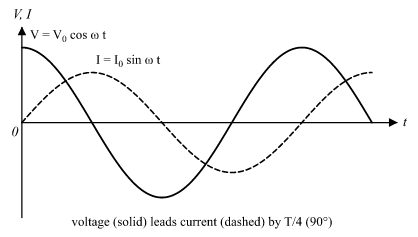
What we are solvingAlternating current: definitions, reactance of a pure inductor, the phase of V and I, a lamp run from the mains with a series inductor, and the hot-wire meterGiven for (c): lamp 120 V, 2 A; mains 240 V, 50 HzChapter: Alternating currentsTopic: Inductive reactance; a.c. meters(a)(i)(1 mark)Alternating current is a current whose magnitude changes periodically with time and whose direction reverses periodically (e.g. I=I0sinωt)(a)(ii)(1 mark)Reactance is the opposition to the flow of alternating current offered by a pure inductor or capacitor (the ratio of the r.m.s p.d. across it to the r.m.s current through it), measured in ohms(b)(i)(4 marks)The changing current induces a back e.m.f −LdtdI; for a pure inductor the applied p.d. must balance it:V=LdtdIWith I=I0sin2πft:V=L×2πfI0cos2πft=V0cos2πft,V0=2πfLI0Reactance:XL=I0V0=IrmsVrms=2πfL(b)(ii)(2 marks)The voltage reaches its peak a quarter of a cycle before the current:
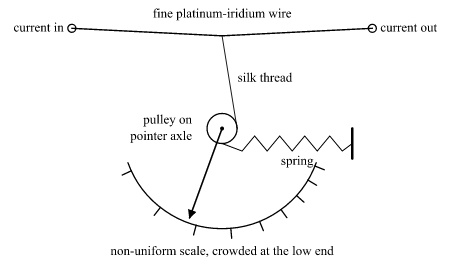
(b)(iii)(2 marks)The current in the inductor induces a back e.m.f that opposes every change in the current, so the applied p.d. must equal LdtdIThis is greatest when the current is changing fastest (as I passes through zero) and zero when I is at its peak, so the voltage leads the current by 2π (a quarter cycle)(c)(i)(3 marks)Resistance of the lamp:R=IV=2120=60ΩImpedance needed for 2 A from 240 V:Z=2240=120ΩZ2=R2+XL2⇒XL=1202−602=10800=103.9Ω(c)(ii)(2 marks)L=2πfXL=2π×50103.9=0.331H(d)(5 marks)A fine platinum-iridium wire is stretched between two terminals; a silk thread tied to its middle passes round a small pulley on the pointer axle and is kept taut by a spring
The alternating current to be measured flows through the wire and heats it (P=I2R); the heating does not depend on the direction of the currentThe wire expands and sags; the spring pulls the thread, which turns the pulley and the pointer moves over the scaleThe expansion depends on the mean heating, i.e. on Irms2, so the meter reads r.m.s values (it is calibrated with direct current)Because the deflection depends on I2, the scale is non-uniform, crowded at the low endAnswer: (b)(i) XL=2πfL; (c)(i) XL≈104Ω; (c)(ii) L≈0.331 HTip: The lamp and inductor p.d.s are 90° apart, so they add as 2402=1202+VL2, not 120+VL