What we are solvingCurrent electricity: resistance, replacing a heater coil, resistors in parallel, a shunt, calibrating an ammeter with a potentiometer, and potentiometer errors
Given for (a)(ii): manganin 20 m, diameter 0.54 mm,
ρ=4.6×10⁻⁷ Ω m; nichrome diameter 0.5 mm,
ρ=10.0×10⁻⁷ Ω m
Given for (b)(ii): coil resistance
10 Ω, full deflection 3 mA, range 1.5 A
Chapter: Current electricity
Topic: Resistance, meters and the potentiometer
(a)(i) (1 mark)Resistance of a conductor is the ratio of the p.d. across it to the current flowing through it (
R=IV), measured in ohms
(a)(ii) (3 marks)Same supply voltage and same power (
P=RV2) means the same resistance:
A1ρ1L1=A2ρ2L2,A=4πd2L2=L1×ρ2ρ1×d12d22L2=20×10.0×10−74.6×10−7×0.5420.52=20×0.46×0.857=7.89 m(b)(i) (3 marks)In parallel, each resistor is connected directly across the supply, so each has the full p.d.
V and carries
RiVIn series the same p.d. is shared among the resistors, so each has only part of
VAlso the combined resistance in parallel (
R1=R11+R21+…) is less than the smallest resistor, while in series it is the sum, so a larger total current is drawn in parallel
(b)(ii) (3 marks)The shunt
S carries the rest of the current:
Is=1.5−0.003=1.497 A
Shunt and meter are in parallel, so they have the same p.d.:
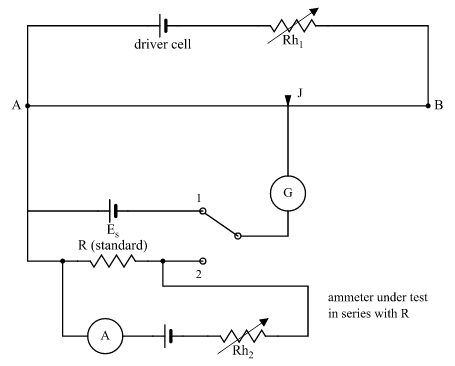
IgRg=IsSS=1.4970.003×10=0.0200 Ω(c)(i) (6 marks)A driver cell (accumulator) and a rheostat are connected across the uniform potentiometer wire AB
Standardise: with the two-way key at 1, balance a standard cell of e.m.f
Es and record the balance length
lsConnect the ammeter in series with a standard resistor
R (e.g.
1 Ω), a battery and a rheostat; with the key at 2, find the balance length
l for the p.d. across
RTrue p.d. across
R:
V=lslEs; true current:
I=RV=lsRlEsRecord the ammeter reading
IA beside the true current
IRepeat for several currents (adjust Rh
2); plot
IA against
I (or the correction
I−IA against
IA) as the calibration curve
(c)(ii) (2 marks)Non-uniform cross-section of the wire, so the p.d. per unit length is not constant
The e.m.f of the driver cell falling during the experiment, and heating of the wire changing its resistance; also end (contact) resistances at A and B
(c)(iii) (2 marks)Any two: the e.m.f of the driver cell is less than the e.m.f or p.d. being measured; the positive terminals are not connected to the same end A of the wire; a broken connection in the circuit; too large a resistance in series with the driver cell
Answer: (a)(ii) 7.89 m of nichrome; (b)(ii) shunt
0.0200 ΩTip: In (a)(ii) work in ratios; the
4π and the
10−7 cancel