What we are solvingElectrostatics: electric field, field of a charged sphere, potential energy of two charges, a charged sphere deflected by a field, charging by friction, and the electroscope
Given for (d):
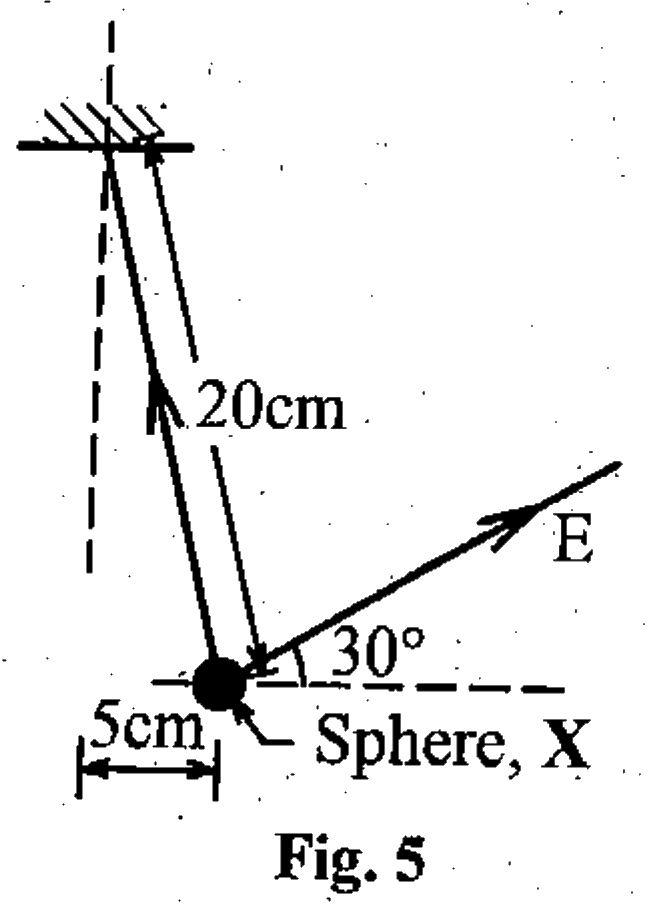
m=80 g, thread 20 cm, horizontal deflection 5 cm,
E=1.5×10⁶ N C−1 at
30∘ above the horizontal
Chapter: Electrostatics
Topic: Electric field and potential; charging
(a)(i) (1 mark)An electric field is a region (space) around a charged body in which another charge experiences an electric force
(a)(ii) (1 mark)Electric field strength at a point is the force acting on a unit positive charge placed at that point (
E=qF, in
N C−1)
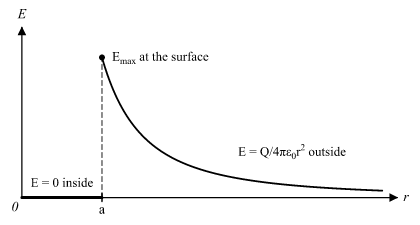
(b) (2 marks)Inside the conducting sphere
E=0; it rises to a maximum at the surface (
r=a) and then falls as
r21 outside
(c)(i) (1 mark)Electric potential energy of a charge at a point is the work done to bring the charge from infinity to that point in the electric field
(c)(ii) (4 marks)Keep
Q1 fixed and bring
Q2 from infinity towards it; at distance
r the repulsive force is
F=4πε0r2Q1Q2Work done against this force in moving
Q2 a small distance
dr towards
Q1:
dW=−FdrTotal work from infinity to
x:
W=−∫∞x4πε0r2Q1Q2dr=[4πε0rQ1Q2]∞xU=4πε0xQ1Q2(d)(i) (2 marks)Angle of the thread with the vertical:
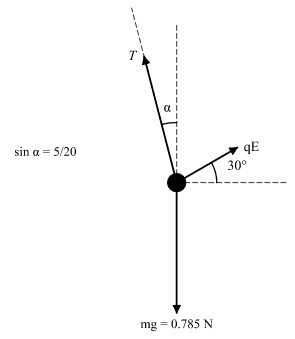
sinα=205=0.25 ⇒ α=14.5∘, cosα=0.968Forces on X: weight
mg, tension
T along the thread, electric force
qE at
30∘ above the horizontal
Horizontal:
qEcos30∘=TsinαVertical:
Tcosα+qEsin30∘=mgEliminate
qE using
qE=cos30∘Tsinα:
T(cosα+sinαtan30∘)=mgT(0.968+0.25×0.577)=0.08×9.811.113T=0.785 ⇒ T=0.705 N(d)(ii) (3 marks)qE=cos30∘Tsinα=0.8660.705×0.25=0.204 Nq=1.5×1060.204=1.36×10⁻⁷ C(e) (3 marks)When two different insulators (e.g. a glass rod and silk) are rubbed together, close contact and the work of rubbing allow electrons to move across the surfaces
Electrons pass from the material that holds them less firmly to the one that holds them more firmly (glass loses electrons to silk)
The body that loses electrons becomes positively charged and the one that gains them becomes negatively charged, with equal amounts of opposite charge; the charge stays where it is because the materials are insulators
(f) (3 marks)As the negative body approaches, it repels electrons from the cap down to the leaf and plate; these neutralise some of the positive charge there, so the leaf divergence decreases
At a certain distance the leaf and plate become neutral and the leaf collapses completely
As the body comes still closer, more electrons are repelled down, the leaf and plate become negatively charged, and the leaf diverges again, more and more
Answer: (d)(i)
T=0.705 N; (d)(ii)
q=1.36×10⁻⁷ C
Tip: In (d) resolve along the horizontal and vertical; the 5 cm and 20 cm only give the angle of the thread